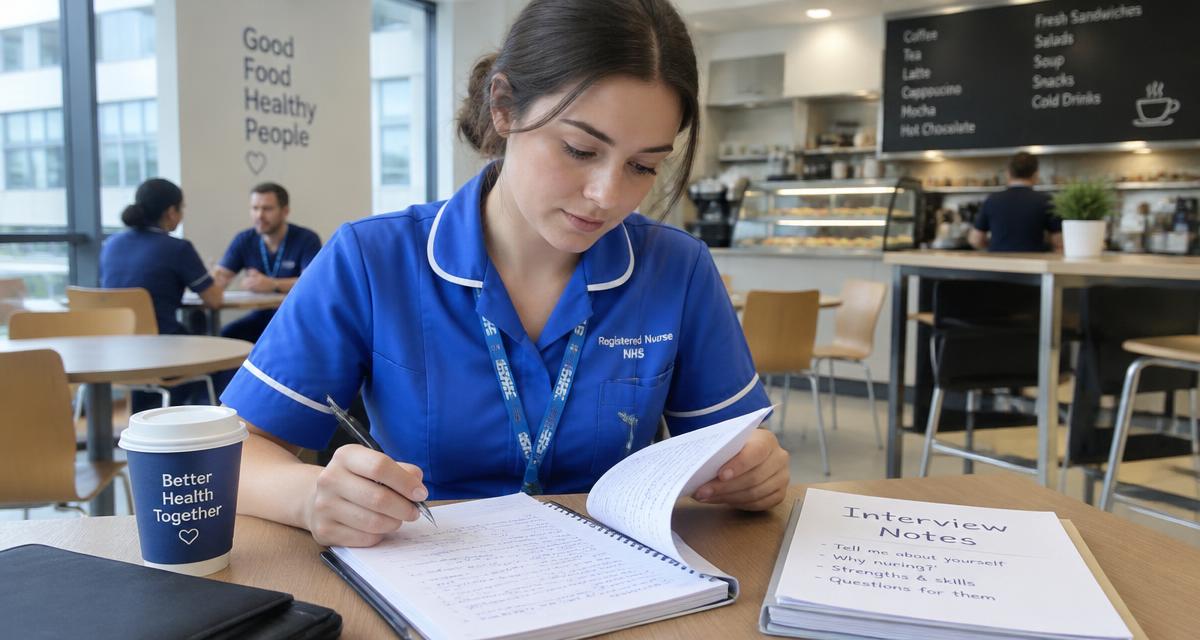
Preparing for an NHS nursing interview involves more than just reviewing your clinical skills. You need to be ready for questions that test your values, judgement, and personal attributes, all framed around the core principles of the NHS. Success lies in preparing specific, real-life examples that showcase your competence and compassion, and linking them directly to the person specification and NHS values.
Understanding the NHS Interview Process
Landing an interview is a huge achievement. Your application, likely submitted via NHS Jobs or a system like Trac, was scored against the person specification, and you made the cut. Now, you have the chance to bring your experience to life.
The NHS uses values-based recruitment. This means the interview panel isn't just looking for clinical competence; they want to see if your personal values align with those in the NHS Constitution. They need to know you're the right fit for their team and, most importantly, for their patients.
Interviews are usually conducted by a panel, which might include a ward manager, a clinical lead or matron, and sometimes a representative from HR. They can be face-to-face or held online via platforms like Microsoft Teams. Don't be surprised if the interview includes a practical test, such as a drug calculation exam or a written prioritisation exercise.
Values-Based Questions
These questions are designed to see how you embody the six core NHS values. The panel wants to hear about real situations where you have demonstrated these principles. Before your interview, spend time thinking of specific examples from your placements, previous roles, or even your personal life if relevant.
The six NHS values are:
- Working together for patients: Patients come first in everything the NHS does.
- Respect and dignity: This applies to patients and colleagues alike.
- Commitment to quality of care: Striving for the best and safest outcomes.
- Compassion: Responding with humanity and kindness.
- Improving lives: A focus on making a positive difference.
- Everyone counts: Ensuring no one is excluded or left behind.
Expect questions like:
- Tell us about a time you worked as part of a multi-disciplinary team to achieve the best outcome for a patient.
- Describe a situation where you had to advocate for a patient.
- How do you ensure you treat every patient with dignity and respect, especially when their beliefs differ from your own?
- Give an example of a time you went above and beyond to provide compassionate care.
- How do you respond to feedback or criticism about your work?
- Tell us about a time you identified a way to improve the quality of care on your ward.
Clinical Scenario and Competency Questions
These questions test your clinical knowledge, problem-solving skills, and ability to practise safely under pressure. The key is to talk the panel through your thought process, always prioritising patient safety and escalating appropriately.
Structure your answers logically. For a deteriorating patient, use a recognised framework like ABCDE (Airway, Breathing, Circulation, Disability, Exposure). For escalating a concern, consider using SBAR (Situation, Background, Assessment, Recommendation). Always mention referring to Trust policies and the NMC Code of Conduct.
Prepare for scenarios such as:
- You arrive on the ward for your shift. How do you prioritise your patient caseload?
- You find a patient collapsed in the bathroom. Talk us through what you would do.
- A patient's relative approaches you and is very angry about the care their mother has received. How do you handle this?
- You are the nurse in charge and a junior colleague tells you they have made a drug error. What actions do you take?
- You witness a colleague speaking to a patient in a disrespectful manner. What do you do?
- A patient’s NEWS2 score has suddenly increased from 2 to 7. What are your immediate actions?
Personal and Career-Focused Questions
The panel wants to hire a person, not just a practitioner. These questions help them understand your motivations, your self-awareness, and your commitment to the role and the Trust. This is where your pre-interview research shines.
Before the interview, thoroughly read the job description and person specification. If you need help tailoring your experience to these documents, our application copilot tool can be a great help even at the interview stage. Research the Trust's values (they are often on their website), recent achievements, and any specific challenges they face. Knowing these details allows you to tailor your answers and show genuine interest.
Common personal questions include:
- Why do you want to work for this Trust?
- Why have you applied for this particular role/speciality?
- What are your main strengths?
- What is your biggest weakness, and what are you doing to improve it?
- How do you cope with the pressures of nursing?
- Where do you see yourself in five years' time?
- What do you understand about clinical governance/safeguarding/the 6Cs?
How to Structure Your Answers: The STAR Method
For any question that asks for an example ("Tell me about a time when..."), the STAR method is your best friend. It provides a simple framework to structure your answer logically and ensures you cover all the key points without rambling.
- S - Situation: Briefly describe the context. Where were you? What was happening?
- T - Task: What was your specific responsibility? What was the goal?
- A - Action: What specific steps did you take? Use "I" statements to focus on your personal contribution.
- R - Result: What was the outcome? What did you learn from the experience?
STAR Method in Action
Question: "Tell me about a time you had to deal with a challenging communication issue."
Here's how a newly qualified Band 5 nurse might answer:
(Situation) "During a placement on a busy surgical ward, I was caring for an elderly patient who had just had major surgery. He was refusing to take his prescribed pain medication because he was worried about becoming addicted to it, but he was clearly in significant pain which was hindering his mobility."
(Task) "My task was to ensure the patient's pain was managed effectively so he could mobilise post-operatively, while also respecting his autonomy and addressing his fears."
(Action) "First, I sat with the patient when I had a quiet moment and asked him to tell me more about his concerns. I listened actively and validated his fears, acknowledging that worries about addiction are common. I then explained in simple terms how post-operative pain can slow down recovery and increase risks like chest infections. I explained the specific medication prescribed, how it worked, and the plan to gradually reduce it as his pain improved. I also involved the pharmacist, who came to speak with him and offered further reassurance. We agreed to try a smaller dose to begin with and review it every hour."
(Result) "The patient agreed to take the medication. His pain score dropped significantly within the hour, and he was able to sit out of bed and mobilise with the physiotherapist later that day. It taught me the importance of taking the time to listen to a patient's underlying fears, rather than just focusing on the immediate task of administering medication. It also showed me the value of using the wider multi-disciplinary team to support patient care."
For more structured guidance and practice, consider using a dedicated resource like our NHS interview pack to refine your examples.
Questions to Ask the Interview Panel
At the end of the interview, you will always be asked if you have any questions. Always have two or three prepared. Asking thoughtful questions shows you are engaged, proactive, and genuinely interested in the role. It's also your opportunity to find out if the job is the right fit for you.
Avoid asking about salary or annual leave, as this is determined by Agenda for Change bands and can be discussed after a job offer. Instead, focus on the role, the team, and your development.
Good questions to ask:
- What does the preceptorship programme look like for new starters here?
- What are the biggest challenges the team is currently facing?
- What opportunities are there for further training and professional development in this role?
- Could you describe the team culture on the ward/in the department?
- What qualities do nurses who excel in this team typically have?
- What are the next steps in the recruitment process and when can I expect to hear from you?
Preparing for your interview is about building a portfolio of evidence to prove you are the right person for the job. You have the skills and experience; the interview is your stage to showcase them. For a comprehensive toolkit to help you prepare, check out our professional CV and interview resources.
Key takeaways
- Thoroughly research the Trust, its values, and the specific department you are applying to.
- Prepare specific, real-world examples that demonstrate how you embody the six NHS values.
- Use the STAR method (Situation, Task, Action, Result) to structure your answers to competency-based questions.
- Practise talking through your thought process for clinical scenarios, always prioritising patient safety and escalation.
- Be ready to talk about your strengths, weaknesses, and career aspirations honestly and reflectively.
- Prepare at least two thoughtful questions to ask the panel about the role, the team, or your development.
- Be yourself. The panel wants to see your personality and your passion for nursing.