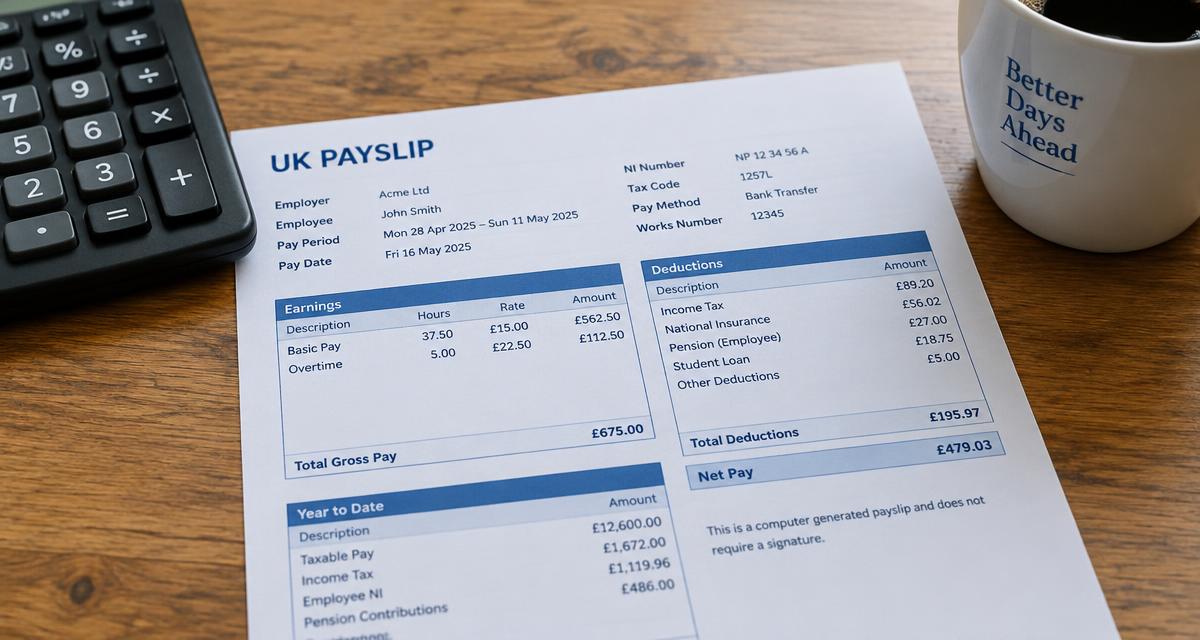
Your NHS payslip is a detailed breakdown of your earnings and deductions for a specific period. It shows your total 'gross' pay, subtracts statutory deductions like tax and National Insurance, your pension contributions, and any other agreed payments, to arrive at your final 'net' or take-home pay. This guide will help you decode each section so you can be confident you're being paid correctly.
Personal and Payroll Information
At the top of your payslip, you’ll find personal and payroll identification details. It’s always worth giving these a quick check to ensure they’re correct.
- Name and Address: Your legal name and home address.
- Assignment/Staff Number: Your unique identification number within your NHS Trust.
- Payroll Number: Another identifier used specifically by the payroll department.
- NI Number: Your unique National Insurance number. This should never change.
- Pay Date: The date the money is scheduled to arrive in your bank account.
- Tax Period: A number from 1 to 12, indicating which month of the tax year you're in (1 is April, 12 is March).
- Tax Code: This tells your employer how much tax-free income you get. For most people with one job, this will be 1257L. This means you have the standard personal allowance of £12,570. If your code is different, it might be because you have a second job, other income, or are paying back tax from a previous year.
- NI Letter: This is usually 'A' for most employees, which means you pay the standard rate of National Insurance.
Understanding Your 'Gross' Pay
This section, often labelled 'Payments', details all the money you’ve earned before any deductions are taken. Your total earnings are your 'gross pay'.
Basic Pay
This is your fundamental salary for your contracted hours, based on your Agenda for Change (AfC) band and spine point. For example, a Band 6 nurse on the top spine point will have a higher basic pay than a newly qualified Band 5. Your basic pay is shown as a portion of your annual salary that corresponds to the pay period (usually a month).
Enhancements and Supplements
Many NHS roles involve working outside standard 9-5 hours, and your pay will reflect this. Common additions include:
- Unsocial Hours/Enhancements: Extra pay for working nights, weekends, or public holidays. These are calculated as a percentage of your basic pay, such as 'time-and-a-half' for a Sunday or bank holiday.
- Overtime: If you work hours beyond your contracted total, you may be paid overtime, typically at an enhanced rate.
- High Cost Area Supplement (HCAS): Also known as 'London weighting', this is an additional payment for staff working in inner, outer, and 'fringe' London areas to help with the higher cost of living.
- Other Payments: You might also see payments for being on-call, recruitment and retention premia (RRPs) for specific roles, or travel expenses.
The Main Deductions: Tax and National Insurance
Deductions are the amounts taken from your gross pay. The biggest are usually Income Tax and National Insurance (NI), which are statutory requirements.
Income Tax
In the UK, you pay tax on earnings above your tax-free Personal Allowance. For the 2026/27 tax year, the standard allowance is £12,570. Any income above this is taxed in bands.
- Basic Rate: You pay 20% tax on earnings between £12,571 and £50,270.
- Higher Rate: You pay 40% tax on earnings above £50,270.
Your payslip will show the amount of tax deducted in this pay period. Remember, your NHS Pension contribution is taken before tax is calculated, which reduces the amount of tax you pay.
National Insurance (NI)
NI contributions fund state benefits like the State Pension, Jobseeker's Allowance, and parts of the NHS itself. You pay NI on earnings above a certain threshold.
For the 2026/27 tax year, as an employee you pay:
- 8% on earnings between £12,570 and £50,270 per year.
- 2% on earnings above £50,270 per year.
The amount of NI you’ve paid for the month will be clearly listed in the deductions column.
The NHS Pension Scheme Explained
Your pension contribution is one of the most significant deductions, but it's also an investment in your future and one of the best employee benefits you have. The NHS Pension is a 'defined benefit' scheme, which provides a guaranteed income in retirement.
Crucially, it operates as a 'net pay arrangement'. This means your contribution is taken from your gross salary before income tax is calculated. This provides immediate tax relief, lowering your overall tax bill.
Your contribution rate is tiered based on your actual pensionable earnings. The rates from April 2025 are:
| Pensionable Earnings | Member Contribution Rate |
|---|---|
| Up to £13,259 | 5.2% |
| £13,260 to £27,288 | 6.5% |
| £27,289 to £33,247 | 8.3% |
| £33,248 to £49,913 | 9.8% |
| £49,914 to £63,994 | 10.7% |
| £63,995 and above | 12.5% |
For every pound you contribute, your employer (the NHS) contributes a very generous 23.7%. Most members are in the 2015 CARE scheme, where you build up a pension equal to 1/54th of your pensionable pay each year. This is then increased annually to protect it from inflation.
Other Common Deductions
Beyond the 'big three', you may see other items listed in your deductions.
- Salary Sacrifice Schemes: These are arrangements where you agree to give up part of your gross salary in return for a non-cash benefit. Because this reduces your gross pay, you save on tax, NI, and sometimes pension contributions. Common examples include lease car schemes and the Cycle to Work scheme.
- Student Loan: If you have a student loan, repayments will be deducted automatically once you earn over a certain threshold. The amount depends on which repayment 'Plan' you are on. Check gov.uk for the latest thresholds.
- Union Subscriptions: If you're a member of a union like the RCN, UNISON, or BMA, your membership fees can be deducted directly from your pay.
- Attachment of Earnings: This is a court order that requires your employer to deduct money from your wages to pay off a debt.
A Worked Example
Let's look at a simplified example. Consider a newly qualified paramedic on a basic annual salary of £29,500, working full-time with a standard tax code (1257L) and no other earnings or deductions.
- Monthly Gross Pay: £29,500 / 12 = £2,458.33
- Pension Contribution: A salary of £29,500 falls into the 8.3% tier. So, the monthly pension deduction is £2,458.33 x 8.3% = £204.04.
- Pay for Tax and NI Calculation: Gross pay remains £2,458.33 for NI, but for tax it is reduced by the pension payment. Taxable pay is £2,458.33 - £204.04 = £2,254.29.
- Income Tax: The monthly tax-free allowance is £12,570 / 12 = £1,047.50. Tax is paid on earnings above this: £2,254.29 - £1,047.50 = £1,206.79. The tax is 20% of this amount: £1,206.79 x 20% = £241.36.
- National Insurance: The monthly NI threshold is also £1,047.50. NI is paid on earnings above this: £2,458.33 - £1,047.50 = £1,410.83. The NI contribution is 8% of this amount: £1,410.83 x 8% = £112.87.
- Total Deductions: £204.04 (Pension) + £241.36 (Tax) + £112.87 (NI) = £558.27.
- Net (Take-Home) Pay: £2,458.33 - £558.27 = £1,899.06.
This is a simplified illustration. You can model your own circumstances using our NHS take-home pay calculator.
Year-to-Date (YTD) Figures
On the right-hand side of your payslip, you'll often see 'YTD' columns. This stands for 'Year to Date' and shows the cumulative total of your earnings and deductions since the start of the tax year (6th April). These figures are useful for keeping track of your total earnings and tax paid over the year, and they should match the P60 form your employer gives you after the tax year ends.
Key takeaways
- Check it every time: Make it a habit to check your payslip each month. Mistakes can happen, and it's easier to sort them out sooner rather than later.
- Gross vs Net: Gross pay is your total earnings before deductions. Net pay is what you actually take home.
- Know your deductions: The main deductions are tax, National Insurance, and your NHS pension. You may have others like student loan repayments or union subs.
- Your pension saves you tax: Pension contributions are taken before tax is calculated, reducing your overall tax bill.
- Check your tax code: For most people, it should be 1257L. If it's different, make sure you understand why. Contact HMRC if you think it's wrong.
- Ask for help: If something doesn't look right or you don't understand an entry, don't hesitate to contact your Trust's payroll department. They are there to help.