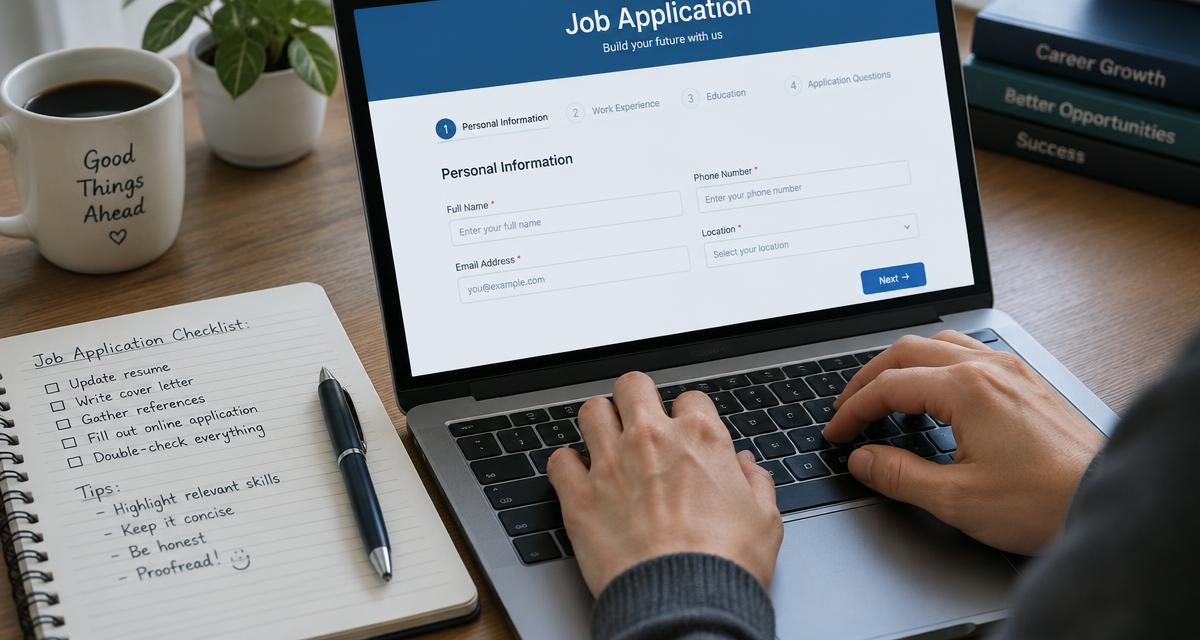
The NHS application form is your first and most important chance to show a hiring manager you’re the right person for the job. Success lies in methodically tailoring your application to the person specification for the role, providing specific evidence for each point, especially in your supporting statement. This guide will walk you through exactly how to do it.
Before you start: understanding the process
Most NHS jobs in England and Wales are advertised on the NHS Jobs website, with Scotland using Job Train and Northern Ireland using HSC Jobs. Many individual trusts and boards manage their recruitment through a system called Trac Jobs, which you’ll often be directed to from the main advert.
Before you write a single word, find and download the Job Description and the Person Specification. These are your most important documents. The person specification lists the ‘essential’ and ‘desirable’ criteria for the role, which can include qualifications, experience, skills, and knowledge. The shortlisting panel will score your application form directly against these points. Your goal is to make it as easy as possible for them to tick every box.
A crucial tip: NHS job adverts can close early if a high number of applications are received. If you see a role you’re interested in, don’t wait until the deadline. Download the documents and aim to start your application as soon as you can.
Breaking down the application form sections
While the supporting statement is where you’ll score the most points, every section needs to be completed accurately and professionally. Let's go through them one by one.
Personal Details & Contact Information
This is straightforward, but triple-check it for typos. An incorrect email address or phone number could mean you miss out on an interview invitation. Ensure the name you use matches your identification documents, as this will be checked later.
Employment History
List your work history in chronological order, with your most recent job first. For each role, include:
- Your job title
- The name of the employer
- Start and end dates
- A brief summary of your key responsibilities and achievements
Don't just copy and paste a list of duties. Use this space to highlight accomplishments relevant to the job you're applying for. Use active verbs and quantify your achievements where possible (e.g., “Mentored two junior colleagues,” “Reduced waiting times by 10% by reorganising clinic schedules”). If you've maintained a professional CV, you'll find this section much easier to complete. You can use our Pro CV builder to help keep your work history organised.
Qualifications and Professional Registration
List your relevant qualifications, usually starting with the highest level achieved. Include the institution, date, and grade. Be precise. If you have a professional registration (like with the NMC or HCPC), ensure your PIN is correct and the expiry date is in the future. Don't leave anything out that's listed as an essential criterion.
References
You'll typically be asked for references covering the last three years of employment, including your most recent or current line manager. It's standard practice for NHS employers to contact referees only after they’ve made a conditional job offer. Always ask your referees for their permission before you list them on your application.
The most important section: your supporting statement
This is where you make your case. The supporting statement (sometimes called 'Additional Information') is your opportunity to demonstrate, with evidence, how you meet every single point on the person specification. Do not simply state that you have a skill; you must prove it.
The best approach is a structured one:
- Use the person specification as a template. Create subheadings in your statement that match the criteria listed, such as 'Communication Skills', 'Clinical Governance', or 'Teamwork'. This makes the shortlister's job easy.
- Address each criterion individually. Go through the essential criteria first, then the desirable. For each one, write a paragraph providing a specific example of how you meet it.
- Use the STAR method. This is a powerful technique for structuring your examples:
- Situation: Briefly describe the context. Where were you? What was the setting?
- Task: What was required of you? What was the goal?
- Action: What did you specifically do? Use “I” statements. Describe your steps and your thought process.
- Result: What was the outcome? How did your actions lead to a positive result? What did you learn?
Weaving in the six core NHS Values is also essential for showing you're a good fit for the organisation's culture. These are: working together for patients; respect and dignity; commitment to quality of care; compassion; improving lives; and everyone counts. Try to show these values in action through your examples.
Writing a compelling supporting statement from scratch can be tough, which is why we built our Application Copilot tool to help you structure your evidence against the person specification.
A worked example: writing a supporting statement point
Let's imagine a Band 5 Staff Nurse with two years of experience is applying for a Band 6 Deputy Ward Manager post. The person specification has an essential criterion: “Experience in leading and coordinating a team during a shift.”
Here’s how they could use the STAR method to answer it:
- Situation: "In my role as a Staff Nurse on a busy 28-bed acute medical ward, we frequently experience periods of high patient acuity and staff shortages."
- Task: "During a night shift last month, the nurse in charge was called away to a family emergency, and as the most senior nurse remaining, I was asked to take over coordination of the shift with a team of one other registered nurse and two healthcare assistants."
- Action: "I immediately led a brief team huddle to review patient needs and re-delegate tasks according to priority and skill mix, ensuring the HCAs were supported with complex patients. I managed two new admissions, coordinated with the on-call doctor to review a deteriorating patient, and ensured all documentation was completed accurately before handover. I made sure to check in with each team member regularly to offer support and maintain morale."
- Result: "As a result of this clear coordination and teamwork, all essential patient care was delivered safely and effectively, and the morning handover was smooth and comprehensive. The ward sister praised my leadership and composure under pressure, and this experience solidified my ambition to move into a role with formal leadership responsibilities."
This example is specific, uses “I” statements, and clearly demonstrates the required skill with a positive outcome.
Final checks and declarations
Before you hit 'submit', take the time to review everything. The final sections of the form are just as important.
- Monitoring Information: This section on equality and diversity is confidential and is not seen by the shortlisting panel. It’s used for monitoring purposes to ensure recruitment is fair.
- Disability Confident Scheme: The NHS is a Disability Confident employer. If you have a disability and meet the essential criteria for the role, you are guaranteed an interview. Declaring this here ensures you are included in the scheme.
- Criminal Convictions: Most NHS roles require a Disclosure and Barring Service (DBS) check. You must be honest about any past convictions. Having a criminal record is not an automatic bar to employment; it will be considered in the context of the role you're applying for.
- Proofread Everything: Read your entire application out loud to catch typos and grammatical errors. Ask a trusted friend or colleague to look over it for you. A polished, error-free application shows your commitment to quality – a core NHS value.
What happens next?
After you submit your application, the process typically follows these steps. Shortlisting panels review all applications after the closing date, which can take one to three weeks. If you are successful, you will be invited for an interview.
If the interview goes well, you’ll receive a ‘conditional offer of employment’. This means the offer is subject to a series of pre-employment checks, which include:
- References from your previous employers
- An enhanced DBS check
- An occupational health assessment
- Verification of your identity and right to work in the UK
- Confirmation of your qualifications and professional registration
These checks can take time. It’s common for the period between a conditional offer and your first day to be between 6 and 12 weeks, so it’s important to be patient and responsive to requests from the recruitment team. Once all checks are complete, you'll receive your unconditional offer and a start date.
Preparing for the next stage is key. You can find resources and common questions in our NHS Interview Pack.
Key takeaways
- Download the job description and person specification before you start. These are the blueprints for your application.
- Tailor every single application. Never use a generic supporting statement.
- Structure your supporting statement using the person specification criteria as headings.
- Use the STAR method (Situation, Task, Action, Result) to provide specific evidence for every point.
- Weave the six NHS Constitution values into your examples to show you’re a good cultural fit.
- Proofread meticulously before submitting, and don't be afraid to ask someone else to check your work.
- Be patient after submission; the pre-employment checking process can take several weeks.