Do I need a CV for an NHS job?
While most roles advertised on NHS Jobs use a detailed application form, a strong CV is still a vital tool in your job-seeking kit. This guide will show you how to create a CV that gets you noticed, whether you're applying directly or using it to complete an application form.
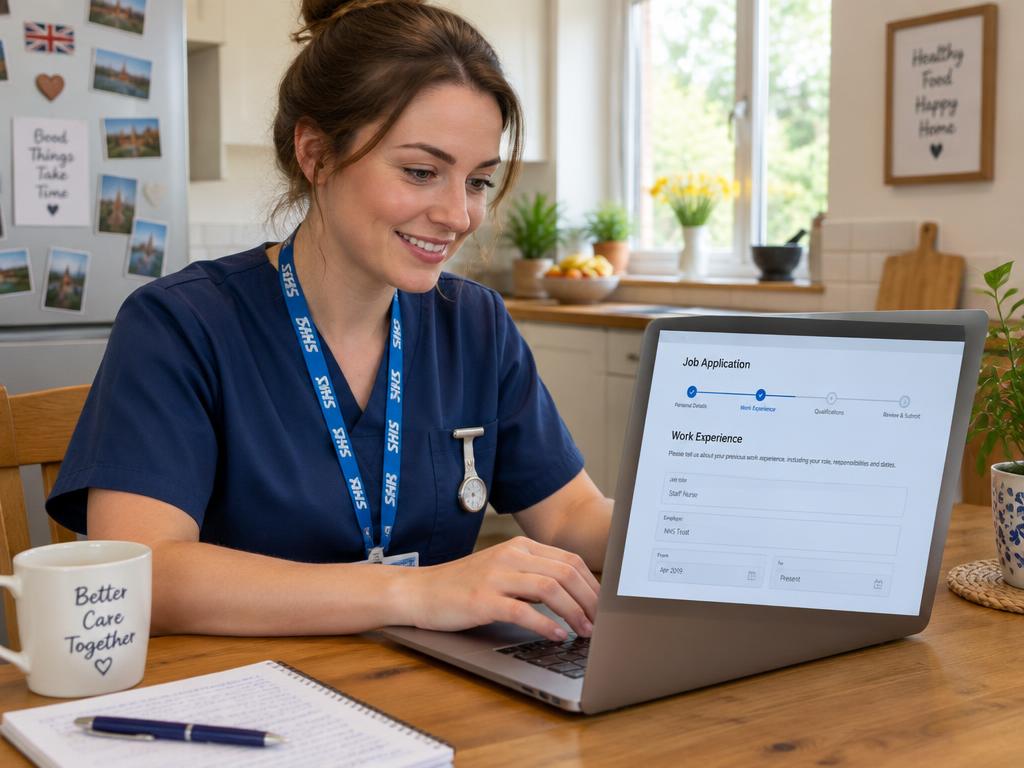
Many NHS trusts use recruitment systems like Trac to manage applications, which often involve filling in your entire work and education history field by field. Having an up-to-date, master CV makes this process much quicker and ensures you don’t forget important details. Furthermore, a traditional CV is often required for:
- Bank, locum or agency work
- Senior and management positions (e.g. Very Senior Manager or medical consultant roles)
- Applying for roles in private healthcare, charities, or other health-related organisations
- Speculative applications to specific departments
Think of your CV as the foundation of your professional identity. Even if you copy and paste from it into an application form, getting the content, structure and tone right is the first step towards your next job.
What makes a great healthcare CV?
A successful NHS or healthcare CV does more than just list your qualifications and past jobs. It tells a story about your skills, your experience, and your commitment to patient care. Recruiters are looking for evidence that you not only have the right technical abilities but also embody the core values of the NHS.
These values, outlined in the NHS Constitution, are central to the health service's values-based recruitment approach. They are:
- Working together for patients
- Respect and dignity
- Commitment to quality of care
- Compassion
- Improving lives
- Everyone counts
Your CV should reflect these values through concrete examples. Instead of just stating you are 'compassionate', describe a time your compassion made a difference to a patient's experience. Instead of saying you are a 'team player', give an example of how you collaborated with a multidisciplinary team to improve an outcome.
The best CVs are clear, concise, and tailored. They are easy to read, free from errors, and directly address the requirements of the job you're applying for. Every statement should be backed up by evidence from your work history or training.
How to structure your CV
A clear, logical structure is essential. Recruiters may spend only a few seconds scanning each CV, so yours needs to be easy to navigate. The reverse-chronological format (most recent experience first) is the standard and most widely accepted layout.
Here’s a breakdown of the key sections to include:
1. Contact Details
Place this at the very top. Include your full name, a professional email address, your phone number, and your general location (e.g., 'Manchester' or 'South London'). You don't need to include your full postal address. Crucially, if you have a professional registration, include it here (e.g., 'NMC Pin: 12A3456B' or 'HCPC Registration: SW12345').
2. Personal Profile
This is a short, powerful summary of 3-4 lines at the start of your CV. It should introduce who you are professionally, highlight your key skills and experience, and state your career objective. Tailor this for every application.
Example for a newly qualified physiotherapist: "A dedicated and HCPC-registered Physiotherapist with recent placement experience in acute medical and outpatient musculoskeletal settings. Passionate about delivering patient-centred care and evidence-based rehabilitation. Seeking a Band 5 rotational role to further develop clinical skills and contribute to a dynamic therapy team."
3. Work Experience
List your jobs in reverse-chronological order. For each role, include your job title, the name of the employer (e.g., 'University Hospitals Bristol and Weston NHS Foundation Trust'), the location, and the dates you worked there. Underneath, use bullet points to describe your responsibilities and, more importantly, your achievements. Use action verbs and quantify your accomplishments where possible.
4. Education and Qualifications
Again, in reverse-chronological order. Start with your most recent and relevant qualification, such as your nursing degree or medical degree. Include the name of the institution and the date of qualification. You can also include key A-Level subjects or equivalent qualifications, but there's no need to list all your GCSEs unless the person specification specifically asks for them.
5. Professional Development and Skills
This is a great place to highlight specific clinical skills, IT competencies (e.g., proficient in using EPR systems like Cerner or Epic), and any recent training or CPD (Continuing Professional Development) you've undertaken. You could use subheadings like 'Clinical Skills', 'IT Skills', and 'Certificates' to keep it organised.
6. References
Simply stating "References are available on request" is perfectly acceptable and standard practice. You will be asked for details later in the process.
Tailoring your CV to the person specification
This is the single most important step in creating a successful application. Every NHS job advert comes with a 'Person Specification' document, which lists the 'Essential' and 'Desirable' criteria for the role. These criteria are what the hiring manager will use to score your application.
Your task is to go through the person specification point by point and ensure your CV provides clear evidence that you meet each criterion. Mirror the language used in the document.
- If it asks for "experience of mentoring junior staff," make sure a bullet point in your work history reads something like, "Mentored and supervised two new Band 5 nurses, providing guidance on clinical skills and trust policies."
- If it requires "excellent communication skills," provide an example: "Effectively communicated complex and sensitive information to patients and their families, adapting my style to overcome barriers to understanding."
Your CV and supporting statement work together. The CV provides the headlines of your experience, while the supporting statement is where you expand on them, linking them directly to the person specification. Tools like our Application Co-pilot can be incredibly helpful for drafting a supporting statement that hits all the right points.
CV example: Clinical role (Band 6 Nurse)
Let's imagine a Band 5 nurse, Fatima, is applying for a Band 6 Junior Sister role on an acute medical ward. The person specification asks for experience in coordinating shifts and supporting junior colleagues.
Here's how Fatima might present her most recent role on her CV:
Staff Nurse (Band 5) | City General Hospital NHS Trust, Manchester | Sept 2020 – Present
- Provided holistic, patient-centred care on a busy 32-bed acute medical ward, managing a caseload of up to 8 patients per shift.
- Routinely took charge of the ward in the absence of senior staff, coordinating patient flow, delegating tasks, and managing unplanned admissions.
- Acted as a mentor and preceptor for first-year student nurses and newly qualified colleagues, providing clinical supervision and completing practice assessment documents.
- Led a quality improvement project to reorganise the ward’s treatment room, resulting in a 15% reduction in time spent locating equipment.
- Competently managed deteriorating patients, initiating appropriate escalation pathways and liaising with the Critical Care Outreach Team.
Notice how Fatima uses active verbs ('provided', 'coordinated', 'mentored', 'led') and includes specific details that directly address the likely requirements of a Band 6 role.
CV example: Non-clinical role (Band 3 Administrator)
Now let's consider David, who is applying for a Band 3 Ward Administrator role. His background is in retail administration, but he wants to move into the NHS. He needs to highlight his transferable skills.
Here's a section of his CV:
Stockroom Administrator | National Retail Group, Birmingham | June 2019 – Present
- Managed a complex and fast-changing schedule for a team of 15 staff, ensuring adequate cover during peak times and processing annual leave requests.
- Maintained 100% accuracy in the electronic stock management database, handling confidential commercial data with precision.
- Acted as the first point of contact for telephone and email enquiries from other stores and head office, resolving issues promptly and professionally.
- Handled sensitive information, such as staff performance data, with complete discretion and in line with company policy on data protection.
- Proficient in all Microsoft Office applications, with advanced skills in Excel for creating staff rotas and tracking stock levels.
David cleverly frames his retail experience in a way that aligns with the duties of a ward administrator: scheduling, data accuracy, being a point of contact, and confidentiality. He shows he has the core skills, even if the setting was different.
Creating a professional CV from scratch can be challenging. Using a structured tool like our Pro CV builder can help ensure you include all the necessary sections in a clean, effective format.
Key takeaways
- Even when an application form is required, a master CV is an essential tool for any NHS job seeker.
- Structure your CV clearly with standard sections like 'Contact Details', 'Profile', 'Work Experience', and 'Education'.
- The person specification is your cheat sheet. Tailor your CV to explicitly prove you meet the essential and desirable criteria.
- Use your CV to show, not just tell. Provide concrete examples and achievements that reflect the NHS values.
- Focus on transferable skills if you're moving into healthcare from another sector.
- Always proofread your CV carefully. A single spelling mistake can create a poor first impression.
- Once your CV has secured you an interview, your preparation enters the next phase. Be sure to check out resources like our NHS Interview Pack.