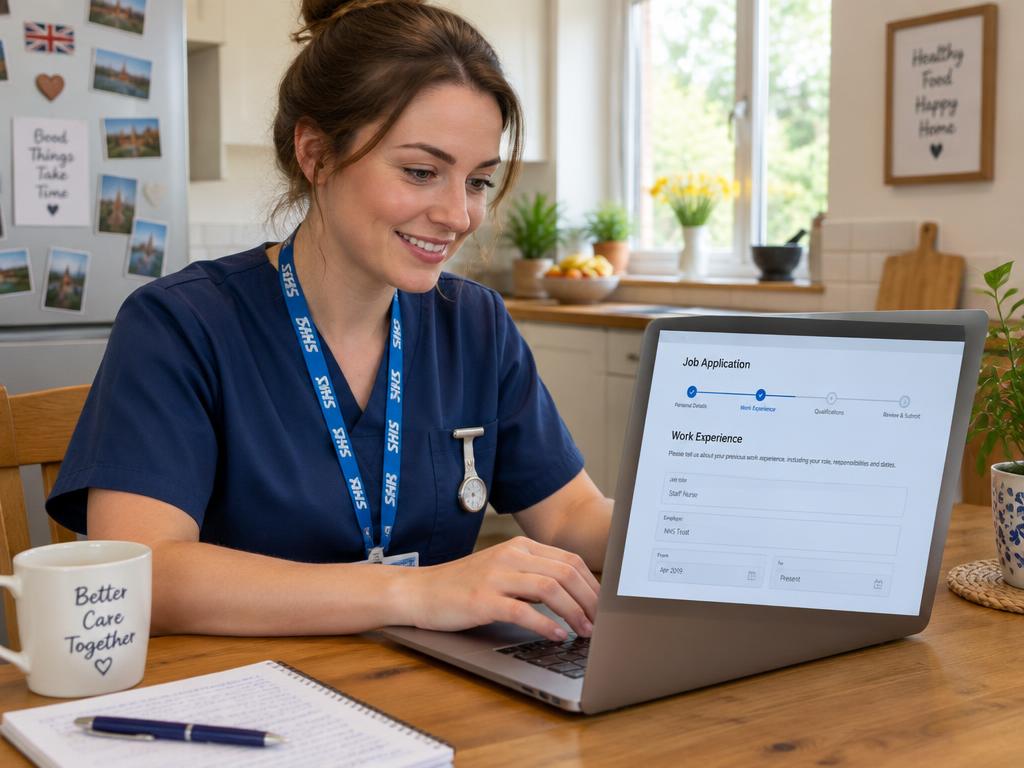
Shortlisting for an NHS job via the Trac system typically takes between one and three weeks from the closing date of the advert. However, this is only an average, and the actual time can vary significantly depending on the role, the number of applicants, and the availability of the hiring manager.
If you haven't heard anything after a month, it's often a sign that your application was unfortunately unsuccessful on this occasion.
What is Trac and how does it fit into NHS recruitment?
When you browse for jobs in the NHS, you’ll likely start on a national job board. For England and Wales, this is the official NHS Jobs website. In Scotland, it’s Job Train, and in Northern Ireland, it’s HSC Jobs.
While these sites are the public 'shop window' for vacancies, many individual NHS trusts use their own internal software to manage the applications they receive. One of the most common systems is called Trac Jobs. It's an Applicant Tracking System (ATS) that handles everything from receiving your application to processing pre-employment checks for the successful candidate.
So, you might find a job on NHS Jobs, click 'Apply', and then find yourself redirected to a Trac portal to complete your application. This is perfectly normal. Your application is then held securely within that Trust's Trac system for the hiring manager to review.
The journey of your application: From 'Submit' to shortlist
Once you've painstakingly completed your application form and polished your supporting statement, you'll hit the 'Submit' button. From your perspective, the hard work is done. But behind the scenes, your application is just beginning its journey.
Here's what happens next:
- Application received: Your application lands in the Trac system, logged against the specific vacancy. You should see its status update to 'Submitted' or 'Application Received' in your account.
- Waiting for the closing date: Your application will sit in the system alongside all the others until the job advert expires. Nothing usually happens before this date.
- Early closure: It's important to note that many NHS jobs state they may close early if a high volume of applications is received. If a hiring manager is aiming for 50 applications and they get 150 in the first three days, they may shut the advert to avoid being overwhelmed. This is why it’s always best to apply sooner rather than later.
Once the closing date passes (or the advert is closed early), the recruitment team collates all the applications and makes them available to the shortlisting panel, which is led by the hiring manager for the post.
How the shortlisting process actually works
Shortlisting in the NHS isn't a mysterious process. It’s a structured and fair method designed to find the candidates who best match the requirements of the role. A hiring manager, often with one or two colleagues, will review every application against a set of criteria.
The key to this is the Person Specification, which is always attached to the job advert. This document lists the 'essential' and 'desirable' criteria for the job, covering qualifications, experience, skills, and knowledge. The shortlisting panel scores your application, specifically your supporting statement, on how well you demonstrate that you meet each of these points.
To get shortlisted, you must show how you meet all the essential criteria. To stand out, you should also aim to meet as many of the desirable ones as possible. This is why a generic supporting statement rarely works; it needs to be tailored precisely to the person specification. If you need help structuring your evidence, our Application Copilot can guide you through the process.
Alongside skills and experience, the NHS also uses values-based recruitment. This means they are looking for candidates who embody the core values of the NHS Constitution. These include:
- Working together for patients
- Respect and dignity
- Commitment to quality of care
- Compassion
- Improving lives
- Everyone counts
Weaving examples of how you demonstrate these values into your supporting statement can strengthen your application significantly.
Factors that influence the shortlisting timeline
Why does one job take three days to shortlist while another takes three weeks? The speed of the process is influenced by several real-world factors that are often out of the recruitment team's control.
- Number of applicants: A highly specialised Band 8 role might only attract 15 applications, which can be reviewed relatively quickly. In contrast, a Band 3 administrative role could attract over 200, creating a huge administrative task for the manager.
- The hiring manager's schedule: Most hiring managers in the NHS are also clinicians or senior operational staff. They don't stop their day job to recruit. Shortlisting has to be fitted around clinics, ward rounds, on-call shifts, and management meetings. Sickness or annual leave can easily add a week's delay.
- Panel availability: Good practice often requires at least two people to shortlist for fairness and consistency. Coordinating the diaries of two or three busy NHS professionals can be a challenge in itself.
- Urgency of the role: If a post is business-critical (for example, a lone specialist in a vital service), the Trust may prioritise the recruitment and fast-track the shortlisting. For routine, high-volume recruitment (like an annual intake of newly qualified nurses), the timeline is often longer and more fixed.
- Recruitment team workload: The central HR or recruitment department in a large Trust might be handling hundreds of vacancies at any one time. Administrative bottlenecks can sometimes slow down the process of getting applications to managers or sending out interview invitations.
A good tip is to check the job advert for a provisional interview date. If a date is listed, the hiring manager is working towards it, which gives you a strong clue about their intended shortlisting timeframe.
A realistic shortlisting scenario
To see how these factors play out, let's follow a fictional applicant. Anya is a newly qualified physiotherapist applying for a Band 5 rotational role.
- Week 0 (Monday): Anya submits her application via Trac. The closing date is listed as Sunday of the following week.
- Week 2 (Monday): The job closes with 110 applications. The Trust's recruitment team checks them and releases them to the Physiotherapy Service Lead, who is the hiring manager.
- Week 2 (Wednesday): The manager, who has a full patient caseload, blocks out Friday afternoon to review the applications with a Band 7 colleague.
- Week 2 (Friday): They work through the first 60 applications, scoring them against the person specification. They need more time to finish the rest.
- Week 3 (Tuesday): They schedule another session and complete the scoring, identifying eight candidates they wish to interview, including Anya.
- Week 3 (Wednesday): The manager sends the finalised shortlist back to the recruitment team.
- Week 3 (Thursday): The recruitment team processes the outcome. Anya receives an email via Trac inviting her to an interview. The 102 unsuccessful candidates receive an automated notification that they have not been shortlisted.
In this realistic example, the time from the job closing to Anya receiving her invitation was just under two weeks, falling squarely within the typical 1-3 week window.
What to do while you wait
The waiting period can be frustrating, but you can use the time productively.
Things you should do:
- Check your Trac account: The status of your application will change from 'Submitted' to 'Shortlisted' or 'Unsuccessful'. This is often the first place you'll see an update.
- Monitor your emails: Keep a close eye on your inbox and your junk/spam folder. All official communication, including interview invitations, will arrive by email.
- Start interview prep: Don't wait for the invitation. Re-read your application and the person specification, and start thinking about examples you could use to answer common questions. Our NHS Interview Pack can give you a head start.
- Keep applying: Don't pin all your hopes on one application. The job market is competitive, so continue to look for and apply for other suitable roles. Using a tool like our NHS Application Tracker can help you stay organised.
Things you should probably avoid:
- Chasing too early: Resist the temptation to call or email the recruitment team or hiring manager a few days after the closing date. They are juggling many tasks, and chasing won't speed up the process. A polite enquiry after three or four weeks is more reasonable if you've heard nothing at all.
- Assuming the worst (immediately): A week's silence doesn't mean you've been rejected. As we've seen, delays are a normal part of the process.
Key takeaways
- Expect to wait 1-3 weeks for a shortlisting outcome after the closing date, but be prepared for it to take longer.
- Delays are common and are usually caused by high application volumes and the busy schedules of NHS staff.
- Your application is scored methodically against the essential and desirable criteria in the person specification.
- Check the job advert for a provisional interview date, as this gives a good indication of the intended timeline.
- If you haven't heard anything after four weeks, it's likely that you have been unsuccessful this time.
- Use the waiting time productively to prepare for potential interviews and continue your job search.