Joining the National Health Service from overseas is a well-trodden path that involves finding a suitable role, securing a job offer, and applying for a Health and Care Worker visa. This guide walks you through each stage, from searching on NHS Jobs and writing your application to understanding the visa process and pre-employment checks.
Why the NHS recruits internationally
The NHS has a long and proud history of welcoming talented professionals from all over the world. Staff from overseas are a vital part of the NHS workforce, bringing diverse skills, experiences, and perspectives that enrich patient care across the UK.
Recruiting internationally helps the NHS fill skills shortages and ensure it has the dedicated staff it needs to provide high-quality care. In return, the NHS offers a structured career path with excellent training, development opportunities, and one of the UK's most generous pension schemes. It’s a challenging but deeply rewarding environment where you can make a real difference.
Finding and applying for your NHS role
The first step is to find a job that matches your skills and experience. Most NHS vacancies are advertised online, and it’s important to know where to look:
- England and Wales: The main portal is the NHS Jobs website (jobs.nhs.uk).
- Scotland: Vacancies are advertised on Job Train via NHS Scotland Recruitment.
- Northern Ireland: Look for roles on the HSC Jobs portal.
Many NHS trusts use a recruitment system called Trac Jobs to manage their applications, so you will often be directed there from the main NHS Jobs site.
The application form
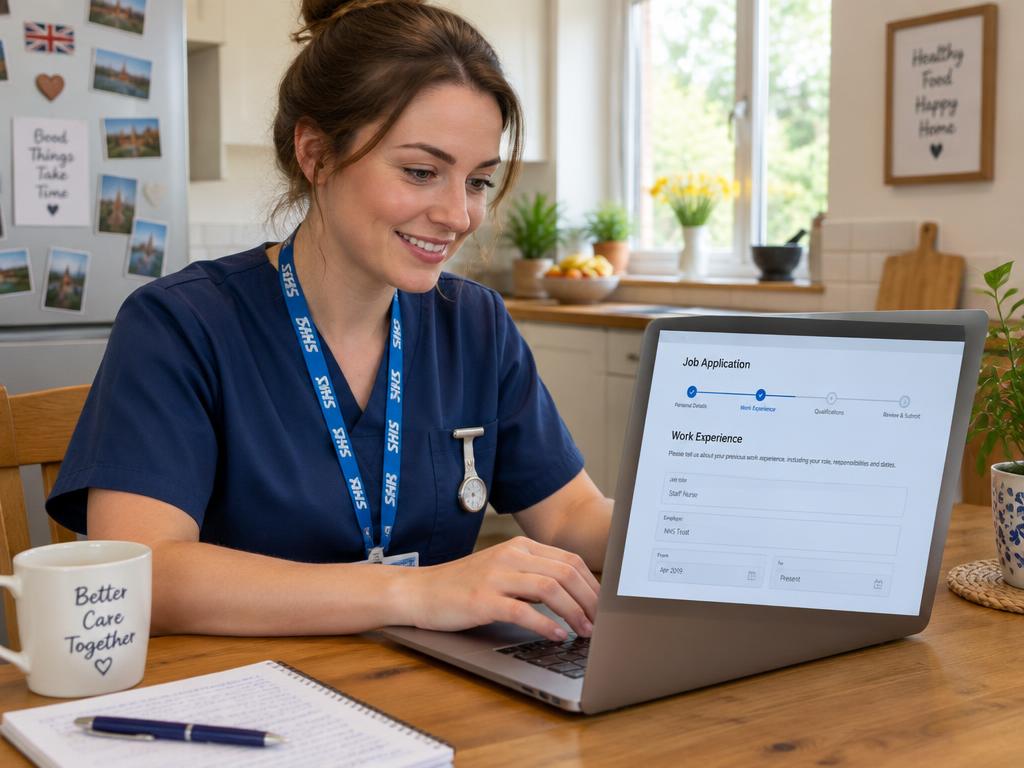
Unlike in some countries where a CV is standard, the NHS uses a detailed online application form. The most important section by far is the ‘Supporting Information’ or ‘Supporting Statement’. This is your chance to show the hiring manager why you are the right person for the job.
Your goal is to demonstrate how you meet every point on the ‘Person Specification’ that comes with the job description. Go through the essential and desirable criteria one by one, providing specific examples from your career that prove you have the required skills and experience. A generic statement will almost always be rejected. We've built a tool to help you structure this crucial part of your application, our Application Co-pilot.
A final tip: NHS job adverts often close early if they receive a large number of applications. If you see a role you’re interested in, it’s best to apply as soon as you can.
Professional registration: A crucial step
Before you can work in a clinical role in the UK, you must be registered with the relevant professional regulatory body. This is a separate process from your job and visa applications, and it can take a significant amount of time, so you should start as early as possible.
The requirements vary for each profession but often include English language tests (like IELTS or OET), exams, and assessments of your qualifications and experience. Key regulators include:
- General Medical Council (GMC): For doctors.
- Nursing and Midwifery Council (NMC): For nurses and midwives.
- Health and Care Professions Council (HCPC): For a wide range of Allied Health Professionals, such as physiotherapists, radiographers, and paramedics.
Your employer will need to see proof of your registration (or that you are in the advanced stages of obtaining it) before they can finalise your job offer and sponsor your visa.
The UK's Health and Care Worker visa
Once you have a job offer from an NHS trust, you can apply for your visa. The primary route for NHS roles is the Health and Care Worker visa, which is part of the wider Skilled Worker route.
To be eligible, you must have a ‘Certificate of Sponsorship’ from your NHS employer for a qualifying role. This visa has several key advantages for healthcare professionals:
- Reduced visa fees: The application fee is lower than for other Skilled Worker visas.
- Exemption from the Immigration Health Surcharge (IHS): This is a significant saving, as the IHS is a mandatory fee for most other visa types that can amount to thousands of pounds.
- A clear path to settlement: After five years in the UK on this visa, you can usually apply to settle permanently (known as indefinite leave to remain).
Immigration rules, eligibility criteria, and fees can and do change. The only official source of information is the gov.uk website. You must check it for the most up-to-date guidance before starting your application.
It's also worth noting that the UK is moving from physical visa documents (Biometric Residence Permits or BRPs) to a fully digital system. By 2025, most visa holders will prove their status online using a 'share code' generated from their UK Visas and Immigration (UKVI) account.
The interview and values-based recruitment
Given the distances involved, interviews for international candidates are almost always conducted remotely via video call (e.g., using Microsoft Teams). The format is usually a panel interview with the hiring manager and one or two other team members.
The NHS uses a ‘values-based recruitment’ approach. This means that as well as assessing your clinical skills and experience, interviewers want to see that your personal values align with those of the NHS Constitution. The six core values are:
- Working together for patients
- Respect and dignity
- Commitment to quality of care
- Compassion
- Improving lives
- Everyone counts
Be prepared to answer questions with specific examples of how you have demonstrated these values in your work. Think about times you have shown compassion, worked effectively in a team, or contributed to improving patient care.
From offer to first day: Pre-employment checks
After a successful interview, you will receive a conditional job offer. The offer is ‘conditional’ because it depends on the successful completion of a series of pre-employment checks. This is a comprehensive process designed to ensure patient safety.
The checks typically include:
- Identity checks: Verifying your passport and other official documents.
- Right to work checks: This will be confirmed by your visa.
- Professional registration and qualifications: Checking your status with the GMC, NMC, or HCPC and verifying your academic certificates.
- Employment history and references: Contacting your previous employers to confirm your work history.
- Criminal record checks: A Disclosure and Barring Service (DBS) check in the UK, plus police clearance certificates from any country you have lived in for 12 months or more over the last 10 years.
- Occupational health clearance: An assessment to ensure you are medically fit to do the job.
This stage requires patience. Gathering all the necessary documents and waiting for the checks to be completed can take time. A typical timeframe from interview to your first day in the job is between 6 and 12 weeks, but it can sometimes be longer. You can use a tool like our NHS Application Tracker to keep on top of all the moving parts.
For example, let's say a Band 5 nurse working 30 hours a week accepts a role. After her video interview, the trust's recruitment team requests her NMC registration pin, references, and a police check from her home country. While they process these, she uses her Certificate of Sponsorship to apply for her visa. The whole process, from her accepting the offer to arriving for her first shift, takes about ten weeks.
Key takeaways
- Start your professional registration process (e.g., with the NMC, GMC, or HCPC) as early as possible, as it can be a lengthy procedure.
- Tailor your application's supporting statement to show exactly how you meet each point on the job's person specification.
- The Health and Care Worker visa is the standard route, offering benefits like reduced fees and an exemption from the Immigration Health Surcharge.
- Always use the official gov.uk website as your primary source for the latest immigration rules and fees, as these can change.
- Prepare for a values-based interview by thinking of real-world examples that demonstrate your compassion, teamwork, and commitment to quality care.
- Be patient during the pre-employment checks, as this comprehensive process can take anywhere from 6 to 12 weeks after your job offer.