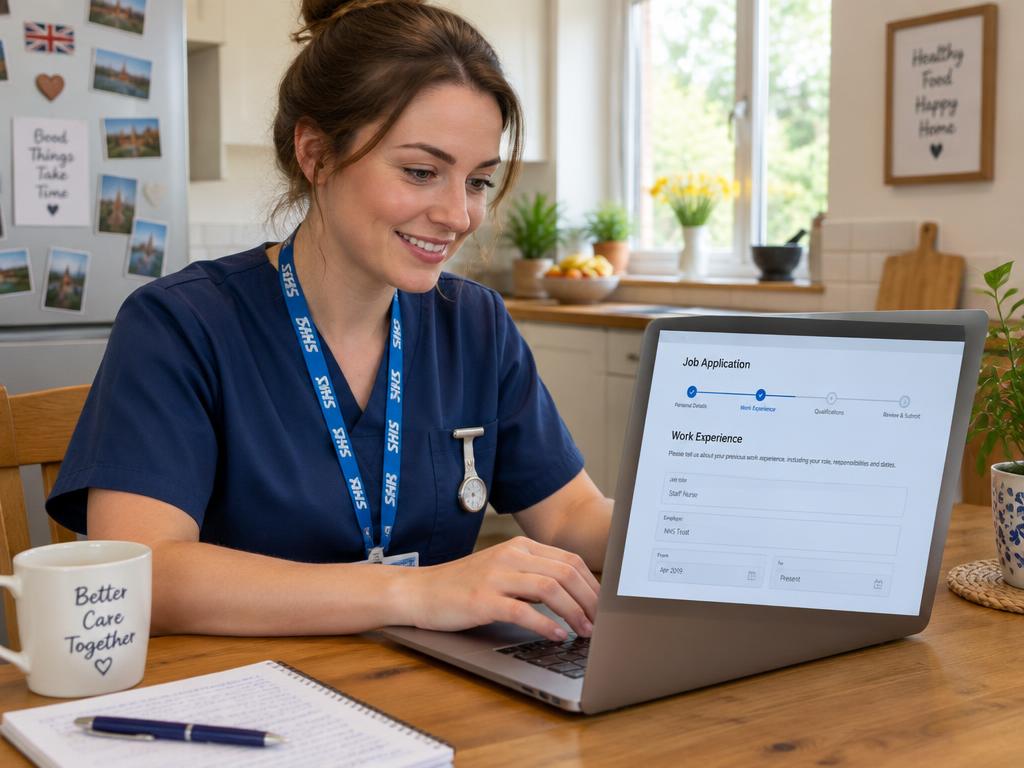
Applying for an NHS job from another country involves a few extra steps, but it’s a well-trodden path. Most applications are made online through a system called Trac, which you are usually directed to from the main NHS Jobs website, and success hinges on tailoring your application to the specific role and demonstrating your understanding of NHS values.
This guide will walk you through finding a suitable role, navigating the Trac application form, and understanding the visa and pre-employment checks you’ll need to complete before you can start your new life working in the UK’s National Health Service.
Finding the Right NHS Job from Overseas
Your journey will likely start on a central job board. In England and Wales, the main site is NHS Jobs. For Scotland, it's Job Train, and for Northern Ireland, it's HSC Jobs. These sites list thousands of clinical and non-clinical roles across the country.
When you find a role you’re interested in, you’ll click ‘Apply’ and often be taken to a separate system to complete the application. Many NHS Trusts use a platform called Trac Jobs for this. Don't be confused by the different names; Trac is simply the recruitment software the employer uses to manage applications. Your focus should be on the content of the application itself.
The most important detail for an international applicant is whether the job offers visa sponsorship. Look for phrases like 'Sponsorship available' or information about the 'Health and Care Worker visa' in the job advert. If it’s not mentioned, the role is unlikely to be open to candidates who require a visa. Applying for roles that don't offer sponsorship will unfortunately be a waste of your time and effort.
A final tip: NHS job adverts can close early if the hiring manager receives a large number of applications. If you find a role that’s a perfect fit, try to apply as soon as you can.
Understanding the Trac Application Form
The Trac application form is a standardised, multi-section online document. It’s designed to be fair and assess every candidate against the same criteria. It asks for facts, not flair, so the key is to be thorough and accurate.
You’ll typically find the following sections:
- Personal Details: Your name, contact information, and address.
- Right to Work in the UK: This is where you declare your current immigration status. You will need to state that you require sponsorship.
- Qualifications: List your professional and academic qualifications. Have your certificates handy so you can input dates and awarding bodies correctly.
- Professional Registration: For roles like nursing, medicine, or allied health professions, you’ll need to provide details of your registration with the relevant UK body (e.g., the Nursing and Midwifery Council - NMC, or the General Medical Council - GMC). If your registration is in progress, state this clearly.
- Employment History: A chronological record of your previous jobs. Include the employer's name, your job title, and the dates you worked there. Be precise and don't leave any unexplained gaps.
- References: You'll usually need to provide contact details for your last few years of employment, including your current or most recent manager. These will only be contacted after a conditional job offer is made.
- Supporting Information: This is the most critical section. It’s a large, blank text box where you make your case for the job. We’ll cover this in detail next.
You can usually save your application and return to it later, which is a good idea. Rushing through it in one sitting often leads to mistakes.
Writing a Standout Supporting Statement
Your supporting statement (sometimes called 'Supporting Information') is your chance to shine. It’s where you move beyond facts and figures and explain why you are the best person for the job. A generic statement that you copy and paste for every application will almost certainly be rejected.
The secret is to use the 'Person Specification' document attached to the job advert. This document lists all the 'essential' and 'desirable' criteria the hiring manager will use to score your application. Your goal is to go through it, point by point, and provide evidence for how you meet each one. Use the criteria as headings to structure your statement.
For each criterion, provide a specific example from your experience. Don't just say "I have good communication skills." Instead, describe a situation where you used those skills to handle a difficult conversation with a patient's family, or to coordinate care with a multi-disciplinary team.
It's also vital to show you understand the values of the NHS. The NHS Constitution outlines six core values:
- Working together for patients
- Respect and dignity
- Commitment to quality of care
- Compassion
- Improving lives
- Everyone counts
Try to weave these values into your examples. For instance, when describing a time you improved a process, you're demonstrating a 'commitment to quality of care'. When you talk about ensuring a patient felt heard, you're showing 'compassion' and 'respect'. Our Application Copilot can help you structure your thoughts and ensure you've covered the key points from the person specification.
A Scenario: Maria Applies for a Nursing Role
Let's imagine Maria, a registered nurse from the Philippines with three years of experience in a busy general hospital. She wants to apply for a Band 5 Staff Nurse role in Manchester. The person specification asks for 'experience of wound care management' as an essential criterion.
A weak statement would be: "During my three years as a nurse, I gained experience in wound care management."
A strong statement, tailored to the person specification, would be:
"Experience of Wound Care Management: In my role at St. Jude's Hospital, I was responsible for the daily assessment and management of a wide variety of wounds, including post-operative incisions, pressure ulcers, and diabetic foot ulcers. I am proficient in applying advanced dressing techniques and using negative pressure wound therapy systems. I worked closely with the tissue viability specialist nurse to develop and implement personalised care plans, ensuring a commitment to quality of care and improving the lives of my patients by promoting faster, more effective healing."
Notice how Maria directly addresses the criterion, provides specific examples of the types of wounds and techniques she's used, and links her experience back to NHS values. She is demonstrating her competence, not just stating it.
The Recruitment Timeline: From Application to Offer
The NHS recruitment process is thorough, so patience is key. After you submit your application on Trac, the following steps take place:
- Shortlisting: The hiring manager and a panel will score all applications against the person specification. Those who score highest are invited to an interview. This can take one to three weeks.
- Interview: As an overseas candidate, your interview will almost certainly be conducted remotely via a video call (e.g., on Microsoft Teams or Zoom). The questions will be a mix of competency-based questions (e.g., "Tell us about a time when...") and values-based questions. Prepare examples that showcase both your skills and your alignment with the NHS Constitution.
- Conditional Offer: If you are successful at the interview, you will receive a 'conditional' job offer. This means the offer is subject to you passing a series of pre-employment checks.
The entire process from submitting your application to receiving an offer can take several weeks. You can keep an eye on your application's progress by logging into the Trac system. To help manage your expectations and any other applications you might have on the go, consider using a tool like our NHS Application Tracker.
Navigating Pre-Employment Checks and Visas
Receiving a conditional offer is a huge milestone, but there are still several important hurdles to clear. The Trust's recruitment team will guide you through this, but it helps to know what to expect. The typical time from interview to your first day can be anywhere from six to twelve weeks, and sometimes longer for international recruits.
The main checks include:
- Right to Work: The Trust will begin the process of applying for a Certificate of Sponsorship (CoS) for you. Once this is issued, you can apply for your Health and Care Worker visa from your home country.
- Professional Registration: You must have completed your registration with the relevant UK body (e.g., NMC for nurses). This often involves passing English language tests (like IELTS or OET) and professional exams (like the CBT and OSCE for nurses). This is a separate process that you manage yourself, but it's a condition of your employment.
- Disclosure and Barring Service (DBS) Check: This is a UK criminal record check. You will also need to provide a police clearance certificate from any country you have lived in for 12 months or more over the last 10 years.
- Occupational Health Check: A health questionnaire and assessment to ensure you are fit to perform the role and to check your immunisation status.
- Reference Checks: The recruitment team will contact the referees you listed on your application form.
The recruitment team will be your main point of contact throughout this stage. Keep in regular contact with them and respond to any requests for information promptly to keep the process moving.
Key takeaways
- Always check that a job advert offers visa sponsorship before you apply.
- The Trac system is just the software; focus on the quality of your application content.
- Your 'Supporting Information' statement is the most important part of your application. Tailor it directly to the 'Person Specification' for each job.
- Use specific examples from your experience to demonstrate how you meet each essential and desirable criterion.
- Show your understanding of the six NHS values in your application and interview answers.
- The process from application to starting work is long. Be patient and stay in regular communication with the recruitment team after you receive a conditional offer.
- Professional registration (e.g., with the NMC or GMC) is a parallel process you must manage alongside your job application.