The National Health Service (NHS) actively recruits talented healthcare professionals from around the world to fill vital roles across the UK. The main route is through a sponsored Health and Care Worker visa, which leads to a formal job offer after a structured application and interview process. Your new NHS employer will then provide extensive support to help you register professionally and settle into your new life in the UK.
Moving to a new country for work is a huge decision, and the process can feel complicated. This guide is here to demystify it. We’ll walk you through each step, from finding a role to your first few weeks in the UK. The NHS has a long and proud history of welcoming colleagues from overseas; you are not just filling a vacancy, you are joining a diverse community that values your skills and experience.
Finding and Applying for NHS Jobs from Overseas
Your journey begins with finding the right role. Unlike in some countries where you might approach hospitals directly, most NHS recruitment is centralised on official job portals. You won’t need to pay a recruitment agency; you can apply directly and for free.
Where to look for vacancies:
- England and Wales: The vast majority of jobs are advertised on the NHS Jobs website.
- Scotland: Look for roles on the NHS Scotland Recruitment site, which uses a system called Jobtrain.
- Northern Ireland: Vacancies are listed on HSC Jobs.
Many NHS trusts use a recruitment system called Trac Jobs to manage their applications, so you may be directed there from an advert on NHS Jobs. This is perfectly normal.
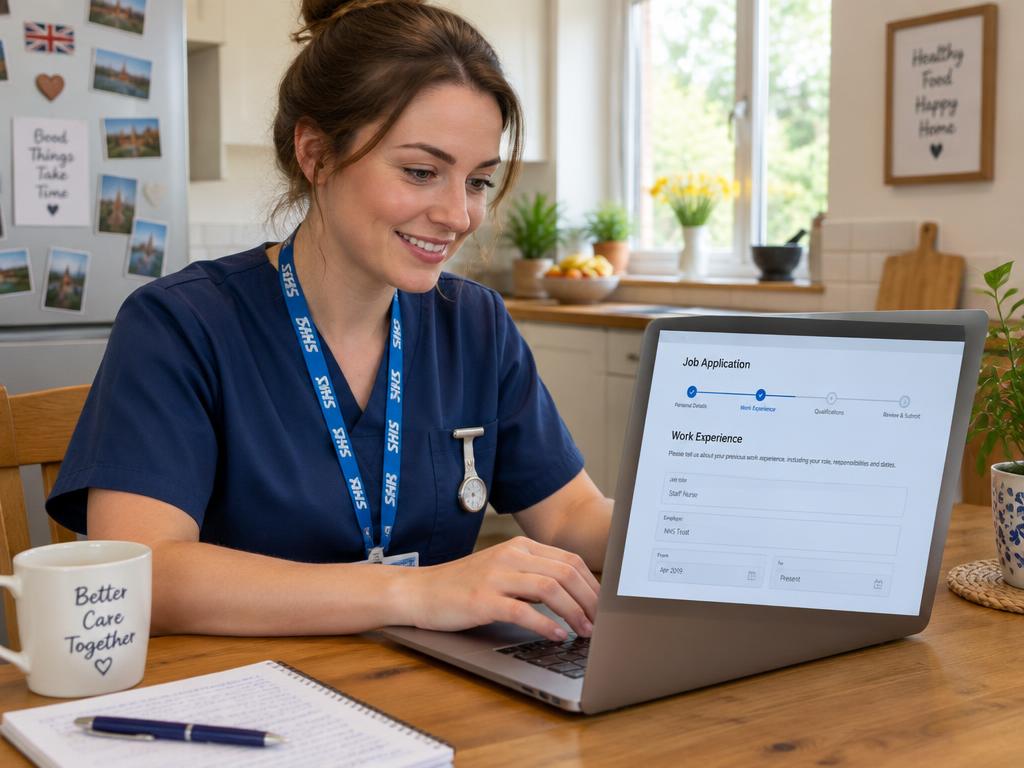
The application itself is usually a detailed online form. The most important part is the ‘supporting information’ or ‘supporting statement’ section. This is your chance to show how your skills, qualifications, and experience match the requirements listed in the ‘person specification’ document attached to the job advert. Your application will be scored against the essential and desirable criteria in this document, so you must address each point with a clear example.
A strong supporting statement is crucial to getting shortlisted for an interview. If you need help structuring your thoughts and making sure you cover all the key points, our Application Co-pilot tool can guide you through the process.
Top tip: NHS job adverts often receive a high volume of applications and may close early once a certain number is reached. If you see a role you’re interested in, try to submit your application as soon as you can.
What the NHS Looks for in Candidates
While your qualifications and clinical skills are vital, the NHS also places a huge emphasis on your values. Recruitment is ‘values-based’, meaning interviewers want to see that your personal values align with those of the NHS Constitution. It’s not just about what you can do, but about how you do it.
The six core NHS values are:
- Working together for patients: This is about collaboration, communication, and putting the patient at the centre of everything.
- Respect and dignity: Treating patients, their families, and your colleagues with consideration and valuing their expertise and opinions.
- Commitment to quality of care: Taking pride in your work, striving for excellence, and being open to learning and improving.
- Compassion: Showing empathy and kindness, and responding to a person's pain, distress, or anxiety with care.
- Improving lives: A focus on making a real difference to people’s health and wellbeing, not just treating illness.
- Everyone counts: Ensuring no one is left behind, marginalised, or discriminated against, and using resources wisely for the benefit of all.
In your application and interview, be prepared to give specific examples from your past experience that demonstrate these values in action. For instance, when asked about ‘working together for patients’, you could describe a time you collaborated with a multidisciplinary team to create a care plan for a complex patient.
The Interview and Offer Process
If your application is successfully shortlisted, you’ll be invited for an interview. For international candidates, this is almost always conducted online using a video conferencing platform like Microsoft Teams or Zoom. The interview panel usually consists of two or three people, including your potential line manager and a clinical specialist.
The questions will be a mix of competency-based questions (e.g., “Tell us about a time you had to manage a difficult situation”) and values-based questions (“How would you ensure a patient is treated with dignity?”). They will all relate back to the person specification. You may also be asked to give a short presentation or complete a written test, but this will be explained in the interview invitation.
Shortly after the interview, you’ll be informed of the outcome. If you are successful, you will receive a ‘conditional offer’ of employment. This means the job is yours, provided you can successfully complete a series of pre-employment checks. These are standard for everyone recruited to the NHS and include:
- Right to Work checks: Verifying your identity and your eligibility to work in the UK (which will be confirmed via your visa).
- Professional Registration: Confirmation that you are registered with the relevant UK body (e.g., NMC, GMC).
- References: The trust will contact your previous employers for references covering a set period, often the last three years.
- Disclosure and Barring Service (DBS) check: A criminal record check. You will likely need to provide a police certificate from your home country as well.
- Occupational Health check: A health screening to ensure you are fit to carry out the role and to arrange any support you might need.
This checking process can take time. For UK-based candidates, the period from interview to starting work is typically 6 to 12 weeks. For international candidates, this can be longer due to the additional steps of visa processing and professional registration.
Visa and Immigration Requirements
To work in the NHS as a non-UK resident, you will need a visa. The primary route is the Health and Care Worker visa. This is a sponsored visa, which means your NHS trust (the employer) provides a ‘Certificate of Sponsorship’ (CoS) as proof that you have a confirmed job offer.
This visa has several advantages for healthcare professionals:
- Lower application fees compared to other skilled worker visas.
- Exemption from the Immigration Health Surcharge (IHS), an annual fee that other visa holders must pay to use the NHS.
- A clear path to settlement (indefinite leave to remain) in the UK after five years.
Your sponsoring trust will guide you through the visa application process, but the application itself is your responsibility. You will need to prove your identity, provide your CoS number, and demonstrate knowledge of English. In most cases, your family members (a partner and any dependent children) can apply to come to the UK with you.
Immigration rules are complex and can change. For the most accurate and up-to-date information, you should always consult the official GOV.UK website.
Professional Registration and Settling In
For any clinical role, you must be registered with the appropriate UK professional regulatory body before you can practise. This is a separate process from your visa application and is a mandatory condition of your employment.
The main bodies are:
- Nursing and Midwifery Council (NMC) for nurses, midwives, and nursing associates.
- General Medical Council (GMC) for doctors.
- Health and Care Professions Council (HCPC) for a range of allied health professionals, such as physiotherapists, radiographers, and paramedics.
The registration process typically involves verifying your qualifications, proving your English language proficiency (usually via an IELTS or OET test), and passing a test of competence. For nurses, this involves passing a practical exam known as the Objective Structured Clinical Examination (OSCE) after you arrive in the UK.
Don’t be daunted by this – NHS trusts provide a huge amount of support. Most will offer a comprehensive OSCE preparation programme, including classroom teaching and practical simulations. They know this is a significant hurdle, and they invest heavily in helping you succeed.
A Realistic Scenario
Let's imagine a scenario. Ana, a qualified radiographer from Spain, accepts a Band 6 position at an NHS trust in Manchester. Her offer is conditional on getting her HCPC registration. The trust's international recruitment team provides her with a welcome pack, a step-by-step guide for the visa application, and puts her in touch with a 'buddy' in the department. While she waits for her visa, they arrange video calls to introduce her to the team. Upon arrival, the trust provides one month's free accommodation, helps her open a bank account, and gives her a full induction to the hospital and the local area.
This level of pastoral support is very common. Trusts understand that moving your life across the world is challenging, and they have dedicated teams to make your transition as smooth as possible.
Key takeaways
- The NHS actively recruits from overseas, and you can apply for jobs directly via official portals like NHS Jobs.
- Applications are scored against a ‘person specification’, and your supporting statement is the most important part of your application.
- Recruitment is based on the six core NHS values, so be prepared to give examples of how you demonstrate them.
- The Health and Care Worker visa is the standard immigration route, sponsored by your employing NHS trust.
- You must gain registration with your UK professional body (e.g., NMC, GMC, HCPC) before you can practise.
- NHS trusts offer extensive support packages, including exam preparation (like the OSCE) and help with settling into the UK.