The National Health Service is the UK's largest employer, offering over 350 different careers that go far beyond the doctors and nurses you see on television. This guide is designed to help you explore the huge range of clinical and non-clinical roles, understand the application process, and find a path that genuinely suits your skills, personality, and ambitions.
So, you're thinking about an NHS career?
Deciding to work in the NHS is a significant choice. It’s an opportunity to contribute to a service that touches every family in the country, to build a stable career, and to do work that truly matters. But with so many options, the first step can feel overwhelming.
Forget the idea that you need a science degree or years of medical training. While those paths are vital, the NHS is a vast, complex organisation that also needs project managers, chefs, IT specialists, administrators, and electricians to function. Whether you're a school leaver, a graduate, or looking for a career change, there is almost certainly a place for you.
The key is to start with yourself. Understanding your own strengths, what you enjoy, and the kind of environment you thrive in will help you narrow down the options and find a role where you can make a real difference.
Understanding the sheer variety of roles
To get a sense of the possibilities, it helps to think about NHS careers in broad groups. While not an exhaustive list, most jobs fall into one of these categories:
- Nursing and Midwifery: This is the largest part of the NHS workforce. Roles include adult, children's, mental health, and learning disability nurses, as well as midwives, health visitors, and nursing associates.
- Medicine: This includes doctors, from junior doctors in training to GPs and specialist consultants in areas like cardiology, oncology, and paediatrics.
- Allied Health Professions (AHPs): A group of 14 distinct professions, including physiotherapists, paramedics, occupational therapists, radiographers, speech and language therapists, and dietitians.
- Healthcare Science: These are the scientists and technicians behind the scenes, working in areas like genetics, medical physics, and pathology to diagnose and treat disease.
- Pharmacy: This group includes pharmacists and pharmacy technicians who work in hospitals and community settings, managing and dispensing medicines.
- Corporate and Admin Services: The backbone of the NHS. This massive category includes everything from HR, finance, and communications to medical secretaries, receptionists, and data analysts.
- Estates and Facilities: The people who keep hospitals running safely and efficiently, including porters, cleaners, maintenance staff, and caterers.
- Management: From ward managers to chief executives, these roles involve leading teams, managing budgets, and planning services to ensure high-quality patient care.
How to find a path that truly suits you
With so much choice, how do you find the right fit? Start by asking yourself some honest questions:
- Who do you want to work with? Do you thrive on direct contact with patients and the public, or do you prefer working behind the scenes in a lab, office, or workshop?
- What kind of environment suits you? Do you want the fast-paced, unpredictable nature of an A&E department, the structured routine of a clinic, or the focus of an administrative office?
- What are your core skills? Are you a practical, hands-on person? A great communicator? An analytical problem-solver? A compassionate listener?
- What are your values? This is especially important in the NHS. Recruitment is 'values-based', meaning employers look for people who demonstrate the principles of the NHS Constitution.
The six core NHS values are:
- Working together for patients
- Respect and dignity
- Commitment to quality of care
- Compassion
- Improving lives
- Everyone counts
Think about times in your life, whether at work, in education, or volunteering, when you have demonstrated these values. This will be essential for your application and interview.
A realistic scenario
Imagine a retail manager wanting a career change. They might feel their skills aren't relevant to healthcare. But their experience in managing a team, handling budgets, dealing with the public, and resolving complaints is a perfect match for roles like a ward administrator, a GP practice manager, or a patient advice and liaison service (PALS) officer. It's all about mapping your existing skills to the needs of the role described in the person specification.
Exploring training and entry routes
One of the biggest myths about the NHS is that every job requires a university degree. While many registered professions do, there are numerous ways to join the service and progress your career.
University Degrees
This is the traditional route for becoming a registered professional like a nurse, physiotherapist, doctor, or pharmacist. Courses typically last three years or more and combine academic study with practical placements. You'll need to check the specific entry requirements for each course, as they often require certain A-Levels or equivalent qualifications.
Apprenticeships
Apprenticeships are a fantastic way to earn a salary while you learn on the job. They are available at all levels, from entry-level roles in business administration or healthcare support right up to degree-level apprenticeships that allow you to qualify as a registered nurse or other health professional without going to university full-time. They are becoming an increasingly popular and respected route into the NHS.
Direct Entry Roles
Many essential roles require no specific healthcare qualifications to get started, just a good standard of general education (like GCSEs in English and Maths) and the right personal values. Roles like Healthcare Assistant, Porter, Cleaner, or Administrative Assistant are vital to the NHS and offer a brilliant entry point. Once you're in, you'll find many opportunities for training and development to help you progress.
Mastering the NHS application process
The application process can feel formal and complex, but it's designed to be fair and transparent. Here’s what you need to know.
Where to find jobs
The vast majority of vacancies are advertised on official websites. In England and Wales, this is the NHS Jobs site (jobs.nhs.uk). Scotland uses Job Train, and Northern Ireland uses HSC Jobs. Many NHS trusts also use a recruitment system called Trac Jobs to manage their applications.
A key tip: if you see a job you're interested in, apply promptly. Adverts often state a closing date but can be closed early if the organisation receives a high number of suitable applications.
The application form
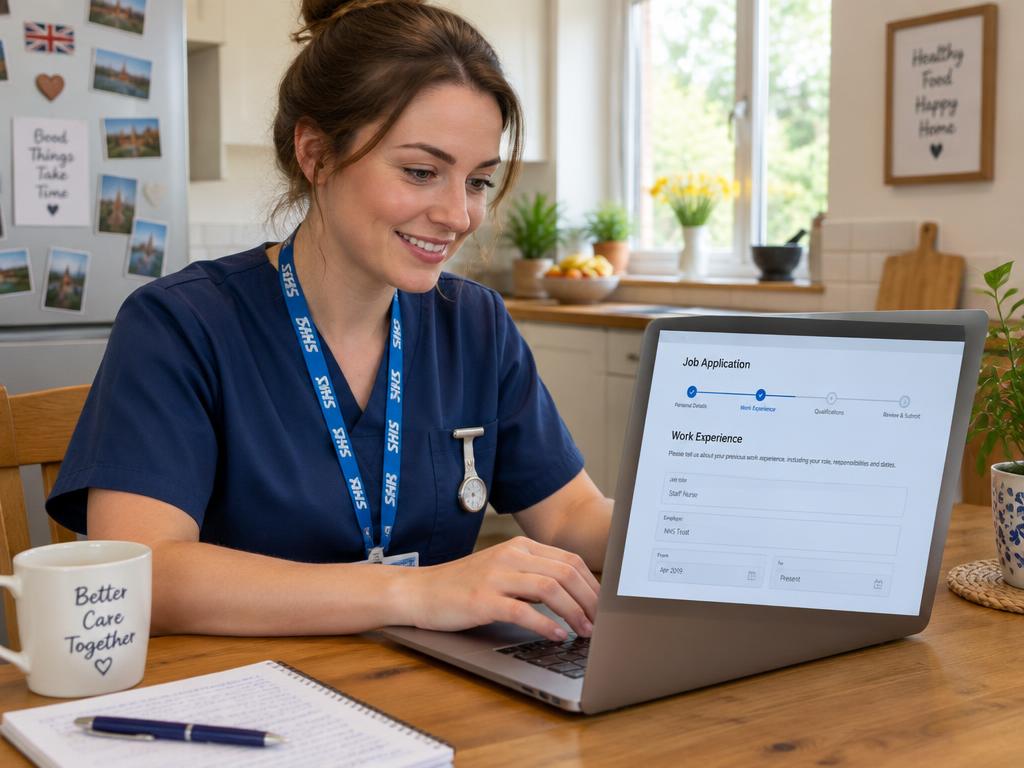
The online application form is standard across the NHS. It will ask for your personal details, qualifications, and employment history. The most important section by far is the 'Supporting Information' or 'Supporting Statement'.
This is your chance to show how you meet the criteria listed in the Person Specification, which is always attached to the job advert. Your statement will be scored against the 'essential' and 'desirable' criteria. You must provide evidence for how you meet each point, using specific examples from your experience. Generic statements are rarely successful.
Writing a compelling supporting statement is crucial. To help structure your thoughts and ensure you address every point in the person specification, you could use a tool like our Application Co-pilot.
From interview to your first day
If your application is shortlisted, you'll be invited to an interview. These are almost always values-based, with questions designed to see how your personal values and behaviours align with those of the NHS Constitution.
If you are offered the job, the process isn't over. The NHS has a duty to keep patients safe, so all new starters must undergo a series of pre-employment checks. These typically include:
- An identity check
- A check of your right to work in the UK
- Verification of your qualifications and registration (if applicable)
- Two or three satisfactory references from previous employers
- A Disclosure and Barring Service (DBS) check (for roles with patient contact)
- An occupational health assessment
Because these checks are so thorough, the process can take time. It's not unusual for there to be a 6 to 12-week gap between your job offer and your first day. Be patient, and keep in touch with the recruitment team. You can use a simple tool like our NHS Application Tracker to keep on top of your progress.
Preparing well for your interview can make all the difference. Our Interview Pack is full of practice questions and tips specifically for NHS roles.
Key takeaways
- The NHS offers over 350 distinct career paths, covering both direct patient care and essential support roles.
- Finding the right role starts with self-reflection on your skills, interests, and what kind of work environment you prefer.
- Your personal values are just as important as your qualifications; recruitment is based on the six core values of the NHS Constitution.
- There are multiple entry routes, including university degrees, apprenticeships, and direct entry roles that offer on-the-job training.
- Your application's 'Supporting Information' statement is the most critical part. You must use it to provide evidence that you meet the criteria in the Person Specification.
- The hiring process is thorough and includes comprehensive pre-employment checks for patient safety, so expect it to take several weeks from job offer to start date.