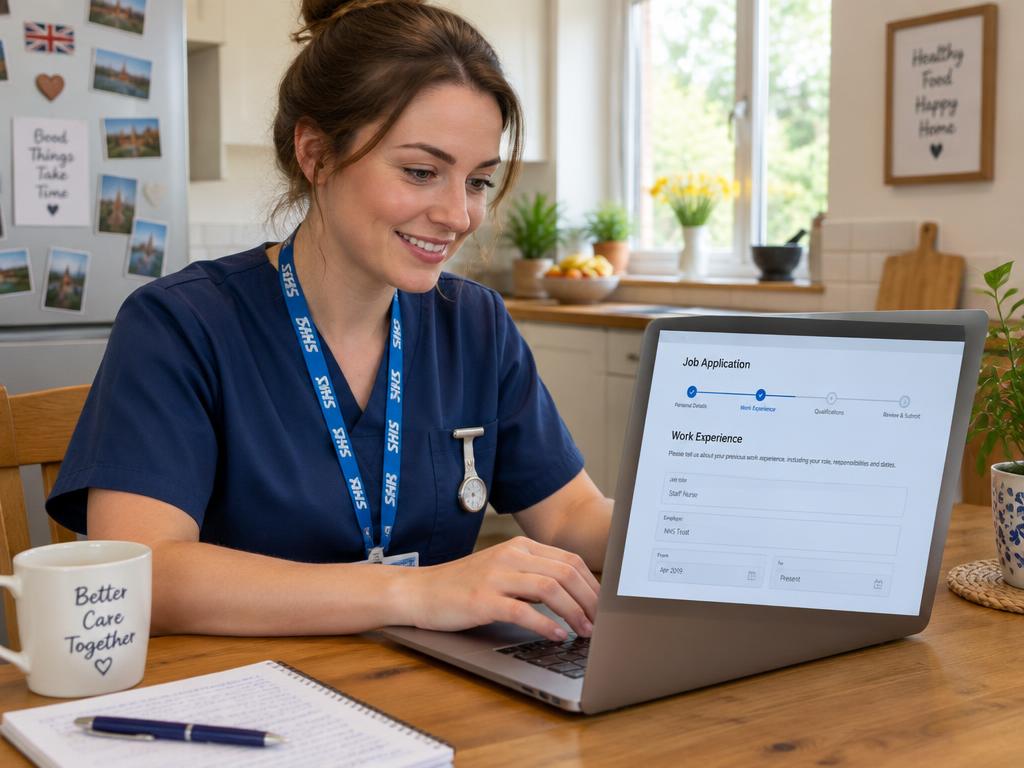
Crafting a CV for an NHS role requires a specific approach that focuses on matching your skills and experience to a detailed person specification. A great NHS CV is a clear, concise, two-page document that highlights your qualifications, clinical or relevant skills, and achievements, all while reflecting the core values of the NHS. It acts as your career passport, ready for any opportunity.
Do you even need a CV for an NHS job?
This is a fair question. The vast majority of NHS jobs in England and Wales are advertised on the NHS Jobs website, with Scotland using Job Train and Northern Ireland using HSC Jobs. The standard application process involves filling out a detailed online form and, crucially, writing a supporting statement. This statement is where you explicitly demonstrate how you meet the 'essential' and 'desirable' criteria listed in the job's person specification.
So, where does a CV fit in? While the online form is primary, you'll often find a CV is either:
- Requested as an upload: Many application systems, like Trac, have a section to upload a CV alongside your main application. A well-crafted CV can provide a quick, digestible overview of your career for a busy hiring manager.
- Essential for certain roles: Very senior management roles (VSM), locum positions, or jobs advertised through recruitment agencies almost always require a traditional CV.
- Your master document: This is perhaps the most important reason to maintain an up-to-date CV. The process of writing it forces you to collate all your job history, qualifications, skills, and achievements in one place. It becomes your single source of truth, making it much faster and easier to complete those lengthy online application forms.
Think of your CV as the comprehensive library of your career, and the application form as the specific essay you're writing for one particular job, drawing key information from that library.
What to include in your NHS CV: A section-by-section guide
A successful NHS CV is clean, professional, and easy to scan. Recruiters spend mere seconds on their first look, so clarity is key. Here’s a breakdown of the essential sections.
Contact Details
Place this at the very top. Include your:
- Full Name: In a slightly larger, bold font.
- Location: Town and county are sufficient. You don't need your full street address.
- Phone Number: Your mobile number is best.
- Email Address: Use a professional-sounding address (e.g., firstname.lastname@email.com).
- Professional Profile Link: A link to your LinkedIn profile is standard. For clinical staff, adding your registration number (e.g., NMC, GMC, HCPC) here makes it instantly visible.
Personal Profile
This is a short, powerful summary of 3-4 lines right below your contact details. It should be tailored to the specific role you're applying for. Think of it as your 'elevator pitch'. Mention your professional title, years of experience, key skills relevant to the post, and what you're aiming for in your next role. For example:
"A compassionate and highly organised Band 6 Registered Nurse with over seven years of experience in acute medical wards. Proven ability in mentoring junior staff, leading on infection control audits, and managing complex patient caseloads. Seeking a Ward Sister/Charge Nurse position to apply leadership skills and a commitment to delivering outstanding patient care."
Work Experience
This is the core of your CV. List your experience in reverse chronological order (most recent job first). For each role, include:
- Job Title
- Employer (e.g., University Hospitals of Leicester NHS Trust)
- Location
- Dates of Employment (Month/Year – Month/Year)
Underneath each role, use 4-6 bullet points to describe your key responsibilities and, most importantly, your achievements. Don't just list what you did; show the impact you had. Use action verbs and quantify your accomplishments with numbers wherever possible.
Education and Qualifications
Again, list these in reverse chronological order. Include the name of the institution, the qualification, and the year you obtained it. There's no need to list all your GCSEs; focus on further education (A-Levels or equivalent), your degree(s), and any postgraduate qualifications.
Professional Registrations & Memberships
This section is non-negotiable for clinical and registered professionals. Create a dedicated space to clearly state your registration body (e.g., Nursing and Midwifery Council, Health and Care Professions Council), your full registration number/PIN, and your revalidation or renewal date. This immediately confirms your professional standing. You can also list memberships of relevant bodies like the Royal College of Nursing (RCN).
Skills
A dedicated skills section can be a great way to highlight your capabilities at a glance. It also helps your CV get noticed by recruitment software that scans for keywords. You could break this down into sub-headings:
- Clinical Skills: (e.g., Venepuncture, Cannulation, Catheterisation, ECG Interpretation)
- IT/System Skills: (e.g., Proficient in Cerner EPR, Datix, HealthRoster)
- Soft Skills: (e.g., Leadership, Mentoring, Conflict Resolution, Patient Advocacy)
Formatting your CV for success
Presentation matters. A messy, cramped CV is hard to read and suggests a lack of attention to detail. Follow these UK-specific formatting rules:
- Length: Keep it to a maximum of two pages of A4. Any longer and you risk losing the reader's attention.
- Photo and Personal Data: Do not include a photograph, your date of birth, or your marital status. This is standard UK practice to prevent unconscious bias.
- Font: Choose a clean, professional font like Calibri, Arial, or Garamond in size 10-12. Use bolding for headings to create a clear structure.
- Layout: Use plenty of white space around your text. Don't be afraid of margins. Bullet points are easier to scan than dense paragraphs.
- File Format: Always save and send your CV as a PDF. This preserves the formatting perfectly across all devices. Name the file sensibly, for example, 'Jane-Doe-CV-2024.pdf'.
If you're looking for help with layout and structure, a dedicated tool can make all the difference. Our Pro CV builder is designed to help you create a professional, well-formatted CV quickly and easily.
Tailoring your CV to the Person Specification
This is the single most important piece of advice for any NHS application. Every NHS job comes with a 'Person Specification' document that lists the essential and desirable criteria for the role. This includes qualifications, experience, skills, and knowledge. Your application is scored directly against this specification.
Your CV and supporting statement must act as a mirror to this document. Go through the person specification with a highlighter and identify the key requirements. Then, make sure your CV contains evidence that you meet them.
For example, if the person specification asks for 'Experience of conducting clinical audits', you must ensure your work experience section has a bullet point that says something like:
"Led a ward-based audit on falls prevention, analysing data from 50 patient records and presenting findings to the senior nursing team, leading to the introduction of a new assessment tool."
This is far more powerful than simply listing 'Clinical Audits' in a skills section. It provides concrete evidence of your ability. Also, remember that the NHS uses values-based recruitment, centred on the six NHS Constitution values. Weave these into your experience. Show, don't tell, how you embody compassion, respect and dignity, and a commitment to quality of care.
A worked example: David's CV update
Let's consider David, a Band 5 Physiotherapist with three years of experience in a rotational post. He wants to apply for a static Band 6 role in musculoskeletal (MSK) outpatients. The person specification heavily emphasises autonomy, caseload management, and supervision of junior staff.
David's old CV bullet point:
- "Treated patients on the MSK outpatient rotation."
This is a passive description of a duty. It doesn't sell his skills.
David's new, tailored CV bullet point:
- "Independently managed a complex caseload of up to 25 MSK outpatient appointments per day, conducting autonomous assessments and creating evidence-based treatment plans."
- "Provided formal and informal supervision for Band 5 rotational physiotherapists and therapy assistants, including offering guidance on complex cases and co-signing notes."
The updated version directly addresses the Band 6 requirements. It uses keywords like 'independently', 'autonomously', and 'supervision'. It quantifies his workload ('25 appointments per day'), demonstrating his ability to handle the demands of the new role. This focused approach is vital when moving up the bands.
When you've perfected your CV, you'll find writing the supporting statement much easier. You can copy and paste your achievement-focused bullet points and expand on them, using a tool like our Application Copilot to help structure your evidence against the person specification.
What not to include on your NHS CV
Just as important as what to include is what to leave out. Avoid these common mistakes:
- A photograph
- Your date of birth, nationality, or marital status
- Your full home address
- Irrelevant hobbies (unless they demonstrate a specific, relevant skill)
- Clichéd phrases like "team player" or "works well under pressure" (show this with examples instead)
- Reasons for leaving previous jobs
- The names and contact details of your referees (simply write "References available on request")
- Any embellishments or untruths – all information will be checked during pre-employment screening.
The journey from application to starting a new NHS role can take time, often 6-12 weeks after an interview due to comprehensive pre-employment checks. Being prepared with a solid CV from the start will make the whole process smoother and set you up for success in securing an interview. If you get that far, our Interview Pack can help you prepare for the next stage.
Key takeaways
- While the online application form and supporting statement are central to NHS recruitment, a strong CV is an invaluable career document.
- Structure your CV with clear sections: Contact Details, Personal Profile, Work Experience, Education, Registrations, and Skills.
- Follow UK conventions: keep it to two pages, use a professional font, and never include a photo or personal data like your date of birth.
- The most critical step is to tailor your CV to the person specification for the job you are applying for. Use its keywords and provide evidence for every criteria.
- Focus on achievements, not just duties. Use action verbs and numbers to demonstrate your impact in previous roles.
- Reflect the NHS values in your descriptions of your work experience, showing how you have put them into practice.