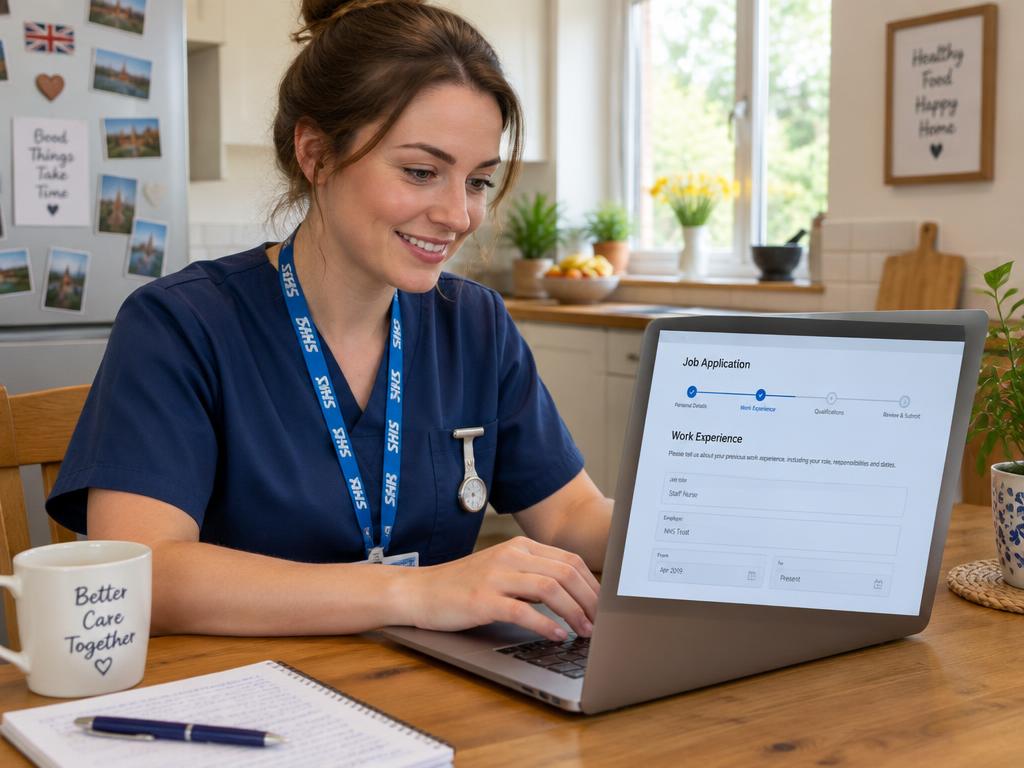
The NHS recruitment process involves finding a job on a national portal, submitting a detailed application scored against a 'person specification', attending a values-based interview, and finally, completing a series of comprehensive pre-employment checks. While it can vary, the period from your interview to your first day typically takes between six and twelve weeks, so patience is key.
Finding and understanding the job advert
Your journey will almost always begin online. The vast majority of NHS jobs are advertised on dedicated national websites:
- England and Wales: NHS Jobs (jobs.nhs.uk)
- Scotland: Jobtrain
- Northern Ireland: HSC Jobs
When you find a role that interests you, the two most important documents to download are the Job Description (JD) and the Person Specification (PS). The JD tells you what the job involves—your duties, responsibilities, and where you fit within the team. The Person Specification, however, is the real key to a successful application.
The PS lists the essential and desirable criteria the ideal candidate must possess. This includes qualifications, skills, experience, and personal attributes. During the shortlisting process, the hiring panel will score your application directly against these points. Think of it as a checklist; your goal is to prove you meet every single one.
A crucial tip: many NHS job adverts close early. If a trust receives a high volume of applications, they may close the vacancy before the advertised deadline to make shortlisting manageable. If you see a job you want, don't wait until the last minute to apply.
Crafting your application
Most NHS applications are completed via an online system, such as Trac Jobs. You’ll fill in standard sections covering your personal details, employment history, and qualifications. But the section that requires the most attention is the 'Supporting Information' or 'Supporting Statement'. This is your chance to shine.
This free-text section is where you make your case for the job. Do not simply upload a generic CV. Instead, you must explicitly show how you meet each point on the Person Specification. The most effective way to do this is to structure your statement using the criteria as headings.
For each criterion—for example, 'Experience of working in a team' or 'Excellent communication skills'—write a concise paragraph explaining how you meet it. Provide specific examples from your previous roles, studies, or voluntary work. Use the STAR method (Situation, Task, Action, Result) to frame your examples clearly and demonstrate your impact.
This methodical approach does two things: it proves to the shortlisting panel that you have read and understood the role, and it makes their job of scoring your application much easier. A well-structured statement that directly mirrors the Person Specification is far more likely to get you an interview. If you need a helping hand structuring your evidence, tools like our Application Co-pilot can guide you through the process.
The shortlisting and interview invitation
After the closing date, a shortlisting panel, usually including the hiring manager, will review and score all the applications. They grade each supporting statement against the essential and desirable criteria from the Person Specification. Candidates who score above a certain threshold are invited to an interview.
You will typically be notified by email through the same portal you applied on (e.g., NHS Jobs or Trac). The time between the job closing and hearing back can vary wildly, from a few days to several weeks, depending on the urgency of the role and the workload of the hiring team. Don't be disheartened by a bit of a wait.
When you receive an invitation, respond as quickly as possible to confirm your attendance. The invitation will provide details on the interview format, who will be on the panel, and whether you need to prepare anything, such as a presentation or a short test.
Preparing for the NHS interview
NHS interviews are almost always 'values-based'. This approach is designed to find candidates whose personal values and behaviours align with those of the NHS Constitution. While your skills and experience are important, recruiters are just as interested in how you work and your attitude towards patients and colleagues.
The six core NHS values are:
- Working together for patients
- Respect and dignity
- Commitment to quality of care
- Compassion
- Improving lives
- Everyone counts
Your interview questions will be designed to explore these areas. For example, instead of asking 'Are you a compassionate person?', they might ask, 'Tell us about a time you showed compassion to a patient or colleague.' Prepare by thinking of specific examples from your career that demonstrate each of these values in action.
Depending on the role, the interview may also include other elements. You might be asked to deliver a pre-prepared presentation, complete a written exercise, or, for clinical roles, work through a scenario-based assessment. The invitation email should clarify the format, but if you're unsure, it's perfectly acceptable to ask the recruitment team for more details. Our NHS Interview Pack can help you prepare for a wide range of common questions.
The offer and pre-employment checks
If you're successful at the interview, you'll usually receive a verbal offer over the phone from the hiring manager. This will be followed up with a formal 'conditional offer of employment' by email.
The word 'conditional' is vital. The offer is entirely dependent on you passing a series of mandatory pre-employment checks. These are rigorous and non-negotiable, designed to ensure patient safety and legal compliance. Do not resign from your current job until these are all complete and you have an unconditional offer.
The checks typically include:
- Identity and Right to Work: Verifying your passport or other official documents.
- Qualifications: Checking certificates for qualifications listed as essential for the role.
- Professional Registration: Confirming your registration with bodies like the NMC or GMC, if applicable.
- References: Seeking satisfactory references covering your last three years of employment.
- DBS Check: A Disclosure and Barring Service check to review your criminal record. The level of check depends on the role.
- Occupational Health: A health assessment to ensure you are fit for the role and to arrange any necessary workplace adjustments.
This stage is the longest part of the entire process. Chasing references and waiting for DBS results can take time. The typical wait from a conditional offer to a confirmed start date is between six and twelve weeks, but it can sometimes be longer.
A realistic timeline: Priya's story
To see how this all fits together, let's follow a realistic example. Priya is a newly-qualified Band 5 Occupational Therapist.
Week 1: Priya sees a job she likes on NHS Jobs. She spends two evenings carefully writing her supporting statement, matching it to the person specification, and submits her application.
Week 3: The advert closes. The hiring manager and a senior colleague begin shortlisting the 70 applications they received.
Week 4: Priya gets an email inviting her to an interview for the following week.
Week 5: She attends the interview. Two days later, the manager calls to offer her the job, which she happily accepts. She receives the conditional offer by email the next day and immediately starts completing the online forms for her checks.
Weeks 6-10: The pre-employment checks are in progress. The trust's recruitment team requests her references. She completes her Occupational Health questionnaire and has a follow-up phone call. Her DBS check is processed. There's a small delay as the team has to chase one of her previous employers for a reference.
Week 11: All checks are finally marked as complete in the system. The recruitment team issues Priya an unconditional offer and her formal contract, confirming a start date in four weeks' time.
Week 11 (end): With the unconditional offer and start date secured, Priya hands in her four-week notice at her current job.
Week 15: Priya has her first day in her new NHS role. The total time from interview to start was ten weeks.
From unconditional offer to your first day
Once you receive your unconditional offer and formal contract, the finish line is in sight. Read your contract carefully and return the signed copy as instructed. You'll also receive information about your first day, including where to go, what to bring, and who to ask for.
Many trusts will send you links to a staff handbook and key policies to read in advance. You may also get details about your induction, which is often split into a 'corporate' induction covering the whole trust and a 'local' induction specific to your department. Now is a great time to plan your finances for your first month; you can use an NHS take-home pay calculator to see what your net pay will be.
Your first few weeks will be a whirlwind of learning new names, systems, and processes. Embrace it, ask plenty of questions, and remember that every single person in the NHS had a first day once, too.
Key takeaways
- Tailor your 'Supporting Information' statement directly to the Person Specification, addressing every point with a specific example.
- Apply for roles as soon as you see them, as popular jobs often close early once enough applications are received.
- Prepare for a values-based interview by thinking of real-world examples that demonstrate the six core NHS Constitution values.
- Be patient during the pre-employment check stage, as this is the longest part of the process and largely outside your control.
- Never, ever resign from your current job until you have received a formal, unconditional offer of employment with a confirmed start date.