
NMC revalidation: the 30-second summary
- Every three years nurses, midwives and nursing associates revalidate to stay on the NMC register.
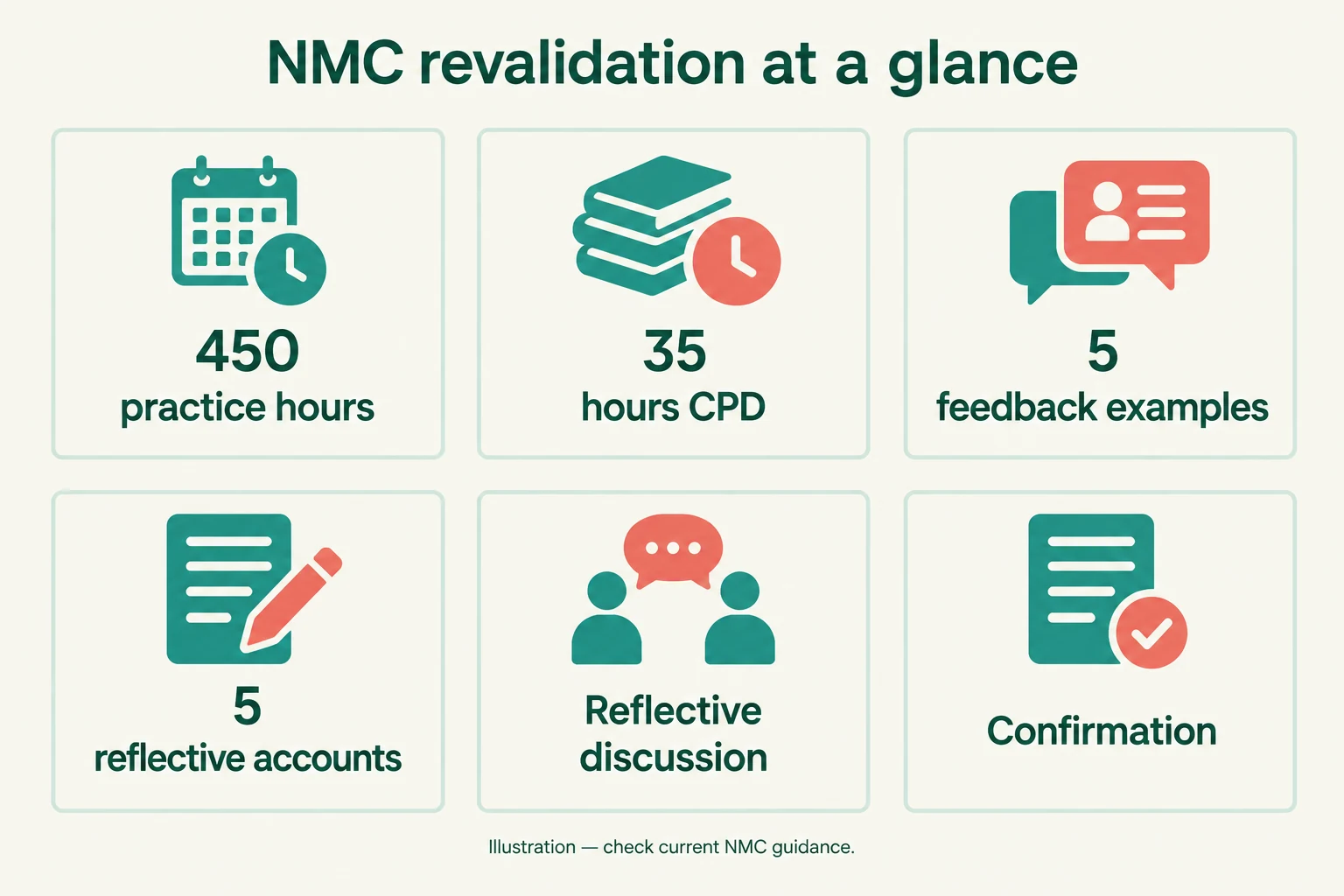
- Evidence: 450 practice hours (more for dual registration), 35 hours of CPD with at least 20 participatory, five pieces of practice-related feedback and five written reflective accounts.
- Discussions: a reflective discussion with another NMC registrant and a confirmation discussion with an appropriate confirmer, ideally your line manager.
- Declarations: health and character, plus an appropriate professional indemnity arrangement.
- Submit in MyNMC: the online application opens 60 days before your revalidation application date. Pay your annual fee as required, too.
Staff Portal is independent and not the NMC. Always check current requirements in the NMC’s guidance and in your MyNMC account.
Revalidation is how the Nursing and Midwifery Council checks that professionals on its register continue to practise safely and effectively in line with the Code. It is not an exam, and the NMC does not prescribe one kind of CPD or one reflective writing style. It does, however, set specific minimums and requires the right forms, signatures and declarations.
This guide turns the official requirements into a practical three-year plan for NHS and independent-sector staff. It explains what counts, what to keep private and how to avoid the common last-minute problems that delay applications.
When is my NMC revalidation due?
Your revalidation date appears in your MyNMC account. The cycle runs for three years from when your registration was last renewed or when you joined the register. The NMC says your online application opens 60 days before your revalidation application date.
- Set reminders well before that 60-day window, especially for your confirmation meeting.
- Keep your email address in MyNMC current so you receive NMC messages.
- Your annual fee is separate from revalidation. Keep paying it under the NMC’s current arrangements.
- If something serious could prevent you meeting the requirements in time, read the NMC’s guidance on extensions before the deadline, not after it.
Do not let your registration lapse. Practising in a role requiring registration without it can have serious consequences for you and your employer.
Requirement 1: practice hours
The NMC requires a minimum number of practice hours over the three-year period. On its practice hours page:
| Registration | Minimum hours in three years |
|---|---|
| Nurse, midwife or nursing associate | 450 |
| Nurse or midwife with SCPHN | 450 |
| Two registrations, such as nurse and midwife | 900 (450 for each) |
| Nurse, midwife and nursing associate | 1,350 |
Hours count when you rely on your skills, knowledge and experience as a registered professional, not only in direct patient care. Management, education, research and policy roles can qualify where they draw on your registration. Record dates, hours, setting, scope of practice, a brief description of the work and evidence such as rotas, timesheets or payslips.
If you have not met the hours, the NMC says you must successfully complete an approved return to practice programme or a Test of Competence before your renewal application. Plan this early if you have had a long break.
Practical ways to track hours
- Download a payslip or roster summary each quarter. Our ESR guide and Employee Online guide explain where many NHS staff find these records.
- Record bank, agency, voluntary and self-employed work separately.
- Do not count study time as practice hours unless it genuinely involved practising in your registered role. Study may count towards CPD instead.
Requirement 2: 35 hours of CPD
You need 35 hours of continuing professional development relevant to your scope of practice in the three-year period. At least 20 of those hours must be participatory learning, which means learning involving interaction with one or more other professionals. It can be face to face or virtual.
For each CPD activity, the NMC requires a record of:
- the method;
- a description of the topic and how it related to your practice;
- the dates;
- the number of hours, including participatory hours;
- the most relevant part of the Code;
- evidence that you completed the activity.
Does mandatory training count as CPD?
It can, if it is relevant to your scope of practice and you record it properly. But think about quality rather than filling hours. A short reflection on what changed in your practice is more useful than a long list of certificates. Mix approaches: workshops, peer learning, conferences, shadowing, clinical supervision, journal clubs, online modules and guided reading.
Examples of participatory learning: a team simulation, an interactive online workshop, a professional conference with discussion or a supervised learning session. Examples usually individual: reading an article alone or completing a solo e-learning module, unless it includes interaction with other professionals.
Requirement 3: five pieces of practice-related feedback
Feedback can be written or verbal, formal or informal. The NMC says it can come from patients and service users, colleagues, managers, team performance reports or appraisal. You need five pieces in the three-year period.
- Record the source type, date, a summary of the content and how you used it to improve.
- Constructive or critical feedback is often more useful for reflection than praise.
- Do not record information that could identify patients, colleagues or others.
- Use the NMC’s recommended feedback log template if it helps keep records consistent.
Feedback is not limited to thank-you cards. A manager’s comments during appraisal, an audit result or a complaint learning review can be valuable if anonymised.
Requirement 4: five written reflective accounts
You need five written reflective accounts on the approved NMC form. Each must refer to an instance of your CPD, practice-related feedback, or an event or experience in your practice, and explain how it relates to the Code.
How to write a good NMC reflective account
- What happened or what was learned? Describe briefly and anonymously.
- What did you learn? Explain the insight, not just the activity.
- How did it change, or how will it change, your practice? Give specific actions.
- How is it relevant to the Code? Name the theme, such as prioritising people, practising effectively, preserving safety or promoting professionalism and trust.
Short anonymised example: “Feedback from a carer showed that discharge information was hard to follow. I now check understanding using teach-back and provide written instructions in plain language. This relates to communicating clearly and respecting people’s needs under the Code.” Your own account should be in your own words and reflect your real practice.
Never include names, dates of birth, NHS numbers, room numbers or rare details that could identify someone. The NMC’s guidance on non-identifiable information applies throughout your portfolio.
Requirement 5: the reflective discussion
You must discuss your five written reflective accounts with another NMC registrant. The NMC says the discussion should take place face to face, and the registrant must sign the approved form with their name, NMC PIN, email, professional address, postcode and the date.
- Choose a registered nurse, midwife or nursing associate. It can be a colleague you work with regularly.
- Share your accounts in advance so the conversation can focus on learning.
- Keep the discussion anonymous when talking about others.
- If your confirmer is an NMC registrant, this discussion can be part of the confirmation discussion.

Requirements 6 and 7: health, character and indemnity
Health and character: you must make a declaration. You must declare charges, convictions (including conditional discharges) and formal cautions, plus any adverse fitness-to-practise determination by a professional or regulatory body. The NMC says you do not need to declare something again if it has already considered it.
Professional indemnity: you must declare you have, or will have when practising, an appropriate arrangement. Many employed NHS staff are covered by the employer. If you are self-employed, work privately or have mixed roles, check your cover for every setting before declaring.
Requirement 8: confirmation and choosing a confirmer
Your confirmer reviews your evidence and confirms you have met the requirements. You provide their name, NMC PIN or other professional identification number where relevant, email, professional address and postcode. The NMC recommends getting confirmation in the final year of your three-year cycle and, where possible, using your line manager.
- Your line manager does not have to be NMC registered.
- If they are not an NMC registrant, your reflective discussion must happen separately with someone who is.
- Share the NMC’s confirmer information before your meeting.
- Bring organised evidence for every requirement.
- Self-employed staff and those without a line manager should check the NMC’s list of appropriate confirmers.
A confirmer is confirming the evidence exists and that you have met the requirements, not judging your fitness to practise in a formal process.
How to submit your NMC revalidation application in MyNMC
- Make sure every requirement and both discussions are complete.
- Sign in to MyNMC when your application window opens.
- Enter practice hours and CPD information as requested.
- Declare feedback, reflective accounts, reflective discussion, health and character and indemnity.
- Add your confirmer’s details.
- Review all entries and submit before the deadline.
- Pay any fee due as instructed and check for confirmation messages.
Keep your evidence after submission. The NMC may select applications for verification and ask for more information. Respond within the timescale given.
NMC revalidation forms and templates
The NMC publishes forms and templates on its forms and templates page. Some are mandatory and some are recommended.
| Record | Typical status |
|---|---|
| Written reflective accounts | Approved form required |
| Reflective discussion | Approved form required |
| Confirmation | Approved form required |
| Practice hours log | Recommended template |
| CPD log | Recommended template |
| Feedback log | Recommended template |
Download templates directly from the NMC so you use current versions. Avoid paid “portfolio” services that ask for your NMC login details.
A simple three-year revalidation plan
| When | Action |
|---|---|
| Year 1 | Set up folders, start hour and CPD logs, collect feedback as it comes. |
| Year 2 | Write at least two or three reflective accounts while events are fresh. |
| Early year 3 | Check totals, fill gaps and book your discussions. |
| Final months | Complete the reflective discussion and confirmation, then submit when MyNMC opens. |
Common NMC revalidation problems
- Not enough participatory CPD.
Look for team training, supervision or interactive virtual sessions. Do not relabel solo activity.
- Reflective accounts are too descriptive.
Focus on learning, change and the Code rather than retelling events.
- Confidential details in your portfolio.
Remove anything identifiable before your discussions.
- No line manager or confirmer.
Check the NMC’s appropriate confirmer guidance early.
- Cannot sign in to MyNMC.
Use the official password reset and contact the NMC through its channels if needed.
- Missed deadline or lapsed registration.
Contact the NMC promptly and tell your employer. Do not practise in a role requiring registration while lapsed.
Worked example: a Band 5 nurse revalidating for the first time
Illustrative scenario. Grace qualified three years ago. She downloads her rota hours each quarter, records mandatory training, ward teaching and a sepsis simulation as CPD and collects anonymised feedback from appraisal, a patient card and a practice educator. In year two she writes reflections on a medicines incident review and on the sepsis simulation.
Six months before her date, Grace finds she has 18 participatory CPD hours, so she joins two interactive study days. She has her reflective discussion with a senior colleague, then confirmation with her ward manager. When MyNMC opens, her evidence is ready and she submits in one sitting.
Career planning? Our Band 5 to Band 6 guide shows how CPD and reflection can support progression too.
Official sources and limitations
Checked on 24 November 2026. NMC requirements and pages can change; the NMC and MyNMC take priority over this guide.
- NMC: revalidation overview and application window
- NMC: what you need to do
- NMC: continuing professional development
- NMC: written reflective accounts
- NMC: confirmation
Staff Portal is not affiliated with the NMC. This is general information, not professional regulatory advice.